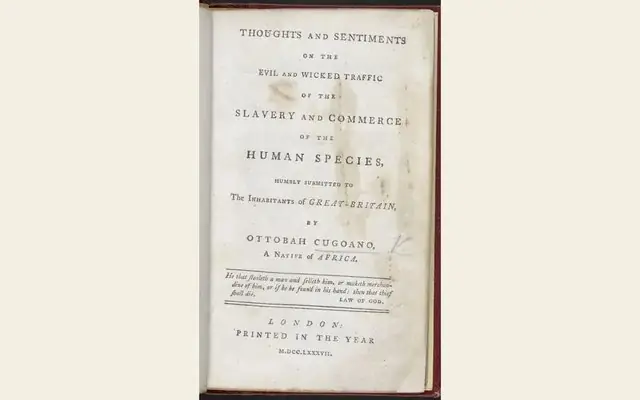
An author addresses the inhabitants of Britain
A title page can announce an argument before its first paragraph begins. Ottobah Cugoano’s 1787 book identified its author as a native of Africa and addressed the inhabitants of Great Britain. The arrangement placed a person who had survived enslavement before a public deeply implicated in it. Thoughts and Sentiments was therefore more than a request for sympathy. Personal experience supported a challenge about the authority to own another human being and about the obligations of those who tolerated the practice. The printed page made that challenge available beyond a single meeting or conversation.
Cugoano came from the Fante region of present-day Ghana and was kidnapped while young, then trafficked into Caribbean enslavement. He reached England in 1772. London Museum emphasizes that the circumstances of his subsequent freedom remain uncertain. Arrival in England should not be represented as an automatic and fully documented legal transformation. The Somerset judgment of the same year restricted forced removal in a particular case, but a judgment, an individual’s circumstances, and the abolition of an institution are different things. Distinguishing them avoids giving his biography an easy resolution unsupported by the surviving evidence.
A baptism and a network in London
A more specific record survives at St James’s, Piccadilly, where he was baptized in 1773 under the name John Stuart. The church’s historical account explicitly warns that baptism did not legally confer freedom from enslavement. It nevertheless interprets his action as an assertion of dignity within a Christian community. This is an important distinction between religious meaning and legal effect. The record supplies a name, a place, and an event. It does not license the invention of an otherwise undocumented liberation ceremony or an exact account of what he privately hoped would follow.
In London he worked for the artists Richard and Maria Cosway and became involved with Black abolitionists associated with the Sons of Africa. His public intervention belonged to a network rather than a solitary awakening. London Museum describes letters, public advocacy, and copies of the book sent to powerful readers. Its collection also contains a French translation published in 1788. A text could move between languages and social settings, although the delivery of a copy does not establish that a particular recipient read or accepted its arguments. Circulation and persuasion are connected but distinct historical questions.
Arguments that deserve a difficult reading
The Stanford Encyclopedia of Philosophy shows how widely those arguments ranged. Cugoano treated enslavement as robbery and challenged appeals to racial hierarchy, warfare, and scripture. St James’s highlights his Christian insistence on a shared human origin and the contradiction between that equality and claims of ownership. Such reasoning turned familiar religious language against people and institutions that defended slavery. His experience mattered, but the argument did not ask readers to condemn only cruelty toward one individual. It confronted the principles through which a wider system represented itself as permissible.
His proposals also contain difficulties that a respectful account should preserve. Stanford’s analysis notes conditions and transitional service within his emancipation scheme, alongside demands extending beyond many contemporary abolitionists. These passages complicate a simple description of every part of the book as an unqualified modern program. They can be examined as political concessions, inconsistencies, or expressions of assumptions current at the time, rather than silently omitted. Taking an author seriously includes reading the parts that resist an uncomplicated commemorative summary. The force of his challenge does not require making the text uniform where it is not.
Editions, missing years, and modern remembrance
The shortened edition of 1791 addressed a different audience and concentrated more heavily on rebutting biblical defenses of slavery. Cugoano’s later whereabouts and death remain unknown. Modern commemoration consequently works around significant absences. At St James’s, a rough slate memorial was designed to mark the anniversary of his baptism. The church explains the material and lettering as deliberate choices, set among other memorials while retaining a distinct character. The plaque is evidence of how an institution remembers him today; the baptismal record and published books remain evidence of his eighteenth-century life and work.
Those objects should be read together without making any one of them stand for everything. The title page establishes a public author, the baptism records a named participant, and the later memorial reflects a community’s act of remembrance. None supplies the missing ending of his life. What survives is substantial enough without that ending: an African author addressed Britain in print, disputed its moral defenses, and forced questions of responsibility into the discussion. Following the evidence preserves both the scale of that intellectual intervention and the limits of what can still be known about its maker.