A chemical question inside ordinary life
Water can look reassuringly clear while leaving important questions unanswered. Food can look familiar while its composition deserves inspection. Ellen Swallow Richards built a career around the value of asking such questions systematically. Chemistry, in her work, belonged not only to specialized materials but to the conditions of everyday life. Her history joins laboratory analysis with education and public communication. The connection is easy to praise in general terms; the more interesting story is how institutions, samples, and practical demonstrations made it possible to turn that connection into sustained work.
Richards earned a degree at Vassar before entering MIT. She was admitted as a special student in 1870, arrived in January 1871, and graduated in 1873. MIT's accounts emphasize the restricted terms of her admission: accepting one woman did not automatically mean that the institution had accepted women on equal general terms. This qualification matters because a celebrated first can conceal the arrangements surrounding it. An individual achievement could reveal what was possible while leaving other prospective students dependent on separate decisions, resources, and opportunities for instruction.
Opening a place to learn the methods
Richards worked to expand those opportunities through the Woman's Laboratory, opened in 1876. There she taught subjects including chemical analysis, industrial chemistry, mineralogy, and biology. The laboratory supplied more than a symbolic place for women to appear in a scientific institution. Students needed methods, equipment, and the practice required to interpret results. Its existence made the educational question concrete: access involved being able to do the work. The special laboratory later closed as women entered the regular student body, a reminder that a useful institution need not remain permanent in its original form.
In 1884, Richards became an instructor in sanitary chemistry. This field directed chemical investigation toward questions involving air, food, and water. It placed familiar substances within a process of collection, comparison, and interpretation. A sample's appearance was a starting point rather than a verdict. Training mattered because an analytical result would be of limited use if nobody understood what had been measured or why different places might produce different values. Richards' work connected technical competence to the practical task of deciding what conditions warranted attention beyond the laboratory.
From water samples to practical decisions
MIT's historical account describes a major Massachusetts water survey commissioned in 1887, involving more than 20,000 samples over two years. Collecting that many samples made comparison across locations possible rather than relying on one representative-looking bottle. The associated mapping work considered regional background levels and deviations linked to human activity. The lesson is methodological as well as historical: a number needs a setting. Without comparison, an unusual result can be misread, while a result that looks ordinary in isolation may reveal a pattern when placed beside evidence from elsewhere.
The survey helped give sanitary chemistry a public purpose. It joined the work of analysts to decisions about shared water resources and waste, showing why investigation required coordination beyond an individual household. That relationship should not be mistaken for a claim that one scientist personally created every subsequent public-health measure. Surveys, institutions, and decisions involve many participants. Richards' contribution is substantial without simplifying that collective setting: chemical evidence could help define a problem that otherwise remained dispersed among private experiences, local assumptions, and the often invisible movement of unwanted material.
Public demonstrations and a durable question
Domestic life supplied another audience for scientific explanation. Richards took part in demonstration kitchens, including the Rumford Kitchen at Chicago's 1893 exposition, and promoted the application of scientific principles to food and household management. These activities brought the language of analysis into places associated with routine work rather than professional laboratories. They also created a communication problem: useful knowledge had to be presented so that people could act upon it. A demonstration was therefore more than an advertisement for expertise; it offered a way to connect an explanation with an observable practical activity.
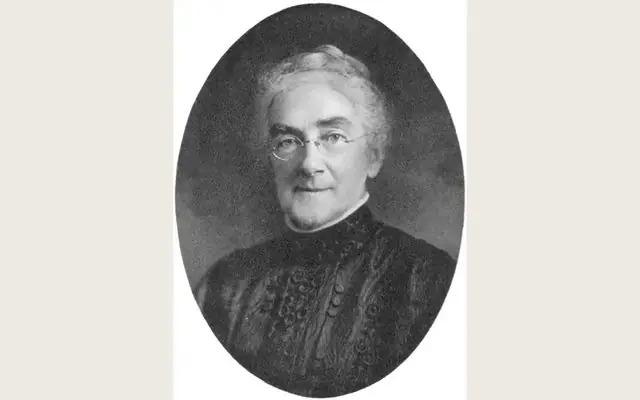
Richards remained associated with MIT until her death in 1911. The portrait accompanying this story belongs to the historical record of her public identity, not to a particular moment in the water survey. Her career is best remembered through the relationships it assembled: between students and instruments, samples and places, scientific measurements and ordinary decisions. It leaves a question that has not lost its force. When the materials of everyday life are too familiar to attract scrutiny, what methods and institutions are needed to make their less visible properties understandable and their consequences open to informed discussion?