Looking beyond a prison gate
A prison can remain close to ordinary city life while keeping its conditions beyond ordinary attention. Elizabeth Fry helped turn that separation into a public question. Her work with women imprisoned at London's Newgate connected visits, teaching, religious conviction, and organized campaigning. It was not a story of one sympathetic encounter solving an institution's problems. Its historical interest lies in how personal attention developed into repeated practical activity and evidence that people outside the prison could no longer easily ignore. The people behind the walls became subjects of reform rather than merely distant punishment.
Fry came from a Quaker background, and her religious beliefs shaped her approach. Accounts of her early visits describe women living in difficult conditions with children among them. Sources differ over whether to date the first visit to 1813 or 1814, so a precise day or a falsely certain year would add little here. The important sequence is clearer: contact with Newgate in the early 1810s developed into sustained work. She sought changes in daily experience rather than treating the prison population as a single undifferentiated moral failure.
Practical work and organized visitors
Education was central to that effort. Reading, religious instruction, and needlework offered forms of occupation and learning within confinement. These activities should be understood in their historical setting. Fry's program was associated with Christian moral reform, not a modern secular account of rehabilitation transplanted into the past. At the same time, attending to education and practical needs challenged an attitude that imprisonment alone was sufficient. The treatment of women and children became something observers could describe, assess, and seek to improve through particular arrangements rather than expressions of general pity.
Organization made visits more than an isolated act of charity. The National Portrait Gallery's educational account identifies the Association for the Improvement of Female Prisoners established in 1817. Women working together could maintain attention and bring practical support into an environment ordinarily governed by others. The collective dimension matters because later portraits and public memory often concentrate responsibility on a single recognizable face. Fry's prominence helped secure attention, but a program involving instruction and repeated visits depended on relationships and sustained participation. A reformer could be influential without working alone.
From testimony to institutional change
In 1818, Fry gave evidence to a parliamentary committee. This moved experience inside the prison into a setting concerned with public decisions. Testimony did not guarantee immediate or complete transformation, yet it gave observations another audience and another possible consequence. London Museum links her wider campaigning with measures associated with the 1823 Gaols Act, including the separation of men and women and provision for female supervision. The distinction between a campaign and a law remains important: many people and political processes stand between describing a problem and changing institutional rules.
The work also extended beyond the first association. A national women's organization for prison reform followed in 1821, broadening the effort beyond one London institution. Such developments make the history less tidy and more informative than a single moment of benevolence. Reform had to persist through committees, expectations, resources, and public debate. Fry's attention to women's imprisonment opened questions about who should supervise prisoners and what conditions were acceptable. Those questions concerned the exercise of authority as well as the character of individual people held under it.
A portrait and a later banknote
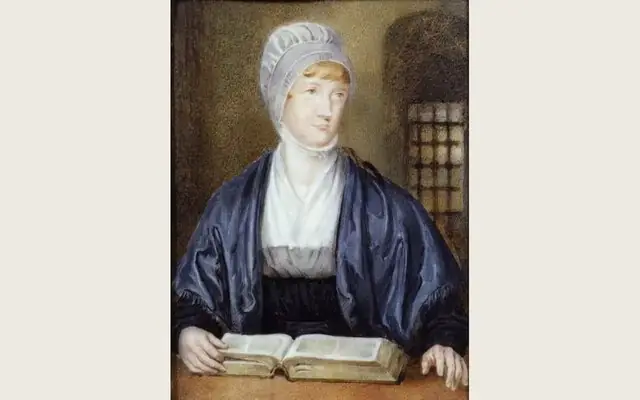
Samuel Drummond's portrait, dated around 1815 by the National Portrait Gallery, offers a different kind of evidence. Fry appears with a plain bonnet and a book identified as the Bible, while prison bars connect her image to the setting of her work. The picture is a composed representation, not a candid photograph of a prison visit. Its selected objects make a case about religious identity and public purpose. Looking at them carefully helps explain how a reformer's reputation could be communicated visually before the later mass circulation of photographic portraits.
Much later, Fry appeared on a British five-pound note issued from 2002 to 2016. The Bank of England's account describes a design connecting her image with her work, showing how a reform campaign became part of national commemoration. That note should not be confused with Drummond's painting or treated as contemporary evidence of Newgate's conditions. Together, these objects reveal successive acts of remembering. The strongest history returns from the familiar face to the sustained work it represents: observing conditions, organizing assistance, and making the use of institutional power answerable to public scrutiny.