Participation recorded within an unequal relationship
A name in a list can reveal participation without proving equality. In William Clark’s journal for 24 November 1805, York appears among the people whose preferences were recorded as the expedition considered winter quarters near the Columbia River’s mouth. His presence is striking because he was enslaved by Clark, rather than an enlisted man choosing service for pay. The document preserves a moment when his opinion was sought within a group making a practical decision. It cannot, by itself, erase the legal and personal power that Clark continued to exercise over him throughout and after the journey.
York’s work extended far beyond attending that discussion. Gateway Arch National Park’s account draws on the journals to describe hunting, scouting, carrying provisions, and caring for sick companions. These were essential activities in a party whose progress depended on food, labor, and cooperation. The same records can reveal him through a named action on one day and leave him almost invisible on another. Reconstructing his contribution therefore requires following scattered entries rather than expecting a continuous biography. The expedition’s written record was created principally by other men, whose interests and vocabulary shaped what later readers inherited.
What a consultation could and could not mean
That vocabulary needs particular care. The journals frequently call York a servant, a term that can obscure his condition when repeated without explanation. An enslaved person could not simply resign from work or decide independently whether to undertake the expedition. The park’s historical account also rejects later racial stereotypes unsupported by the journals. Reading critically means distinguishing evidence of York’s actions from stories imposed on him afterward. His capabilities need neither exaggeration nor a romantic fiction about temporary freedom. A person could exercise skill and judgment within demanding circumstances while remaining subject to coercive authority.
The winter-quarters discussion is often described as a democratic vote. A separate National Park Service interpretation advises a more precise description: the captains consulted the party, including York and Sacagawea, and recorded opinions about where to go. Calling this consultation a first national voting right would attach a much larger legal claim to the evidence than it supports. The practical issues included food, salt, and the relative advantages of different locations. Recognizing the significance of York being heard does not require converting an expeditionary decision into an election conducted under the rules of a later political system.
The return and the requests that Clark resisted
The surviving journal entries show why the distinction matters. Clark’s table associates names with preferences, while Patrick Gass and Joseph Whitehouse describe an evening consultation. Their accounts connect the discussion to crossing the river and investigating wintering possibilities, not to granting citizenship. The documents also differ in detail and emphasis, as records made by several observers often do. Reading them together produces a stronger account than isolating the list as a symbolic image. York’s recorded participation belongs within this concrete decision and the relationships of the traveling party, rather than standing alone as proof that those relationships had become equal.
After the expedition returned in 1806, York sought freedom and wished to live near his wife in Kentucky. The Lewis and Clark National Historic Trail’s account uses Clark’s letters to show resistance to those requests. A short visit did not give York control over where he would subsequently live or work. Clark threatened sale or hiring to a severe master and described physically punishing him. These records expose the limits of any status York had gained on the journey. Useful service and recognition within an expedition had not compelled his enslaver to recognize a right to independent family life.
An uncertain later life and a constructed memory
Accounts of York’s later fate require another distinction between a report and a verified outcome. The trail’s interpretation discusses Clark’s eventual claim to Washington Irving that he had freed York, along with a conflicting story about a Black man living in the West. Neither should be transformed into a confidently narrated final chapter without additional evidence. The uncertainty is part of the surviving history. It reflects unequal control over records as well as the difficulty of connecting later descriptions to one individual. Leaving the outcome open is more responsible than selecting whichever ending seems most consoling or dramatic.
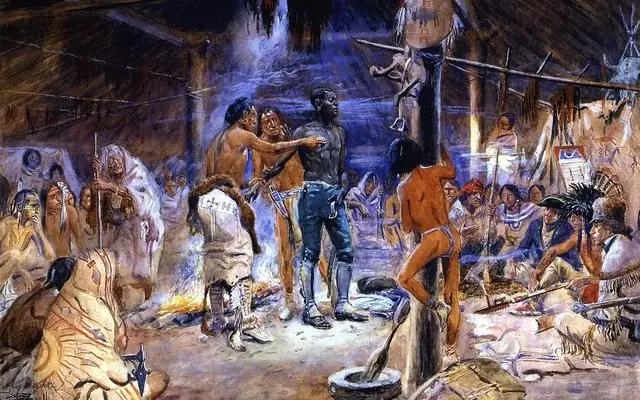
Later remembrance has supplied images that the expedition itself did not preserve. Charles Marion Russell’s painting York, reproduced here, dates from 1908, more than a century after the journey; it is an imagined historical scene, not a likeness made from life. Keeping that distinction visible allows art and documentary evidence to serve different purposes. The journals establish work and participation; correspondence reveals continuing coercion; later pictures show how memory was constructed. Together they offer a demanding human history, in which a person’s contribution can be recognized without allowing a heroic expedition narrative to conceal the freedom he was denied on return.