A visitor who was already an author
On 30 May 1667, Margaret Cavendish attended a meeting of the Royal Society at Arundel House in London. Experiments involving air, heat, and color were arranged for her visit. The Society identifies her as its first female visitor, but visiting was not election to its Fellowship. That distinction matters when an exceptional appearance threatens to stand in for a whole intellectual life. Cavendish was already an author who published under her own name. The more revealing story concerns how she brought arguments into circulation before and after entering a room where women did not ordinarily participate.
Her writing developed across the upheavals of the English civil wars and exile. The Folger Shakespeare Library describes her service to Queen Henrietta Maria, her marriage to William Cavendish, and years in Paris and Antwerp before returning to England in 1660. Books became a means of engaging with ideas beyond the immediate household. Poetry, drama, natural philosophy, and imaginative prose were connected parts of that activity. Her position provided important resources, but resources alone do not explain the decisions visible in her publications. She chose to address questions usually debated within intellectual networks dominated by men.
An argument expressed in more than one form
Observations upon Experimental Philosophy, published in 1666, challenged assumptions surrounding the new experimental science. The Royal Society’s account places it partly in response to Robert Hooke’s Micrographia. Cavendish questioned whether instruments such as microscopes reliably showed objects as they naturally were. This was not simply a refusal to observe. Her position combined ordinary sense experience with rational consideration and speculation. Reducing the disagreement to an opponent of science confronting its champions removes the actual question: how should an observer judge the relationship between an object, an instrument, and the account produced from looking through it?
The Blazing World appeared alongside that philosophical work in 1666. Its imagined journey through a polar passage leads to another world, giving fiction room to explore authority and knowledge. The Folger describes a work combining fantasy, romance, political thought, and philosophical debate. It is often discussed as an early work of science fiction, but that later category should not conceal its mixed forms. Publishing the two works together placed imagined possibilities beside criticism of experimental methods. Cavendish could examine how knowledge was organized through narrative as well as through an explicit philosophical argument.
Books placed in institutional hands
She also took practical steps to place her books before readers. Peterhouse, Cambridge, preserves eleven volumes of her works bearing donation inscriptions. Its exhibition account notes that the dated inscriptions range from 1655 to 1668. The gifts therefore arrived over time, often near publication, rather than as one undifferentiated delivery. This evidence makes circulation concrete. A university library was not merely an abstract audience she hoped to influence. Particular volumes entered a particular collection through acts of presentation, leaving traces that allow later readers to reconstruct something of her sustained effort to secure attention.
A presentation copy carries more information than its printed text alone. The inscription can connect a publication to an institutional recipient and a moment in the author’s career. Peterhouse’s sequence of gifts helps reveal a practice of returning to that audience with further work. It also complicates a simple image of intellectual isolation. Cavendish could be excluded from ordinary participation in certain settings while actively sending her ideas into others. Access was uneven, and the books did not remove that inequality, but their surviving presence shows that her response included deliberate work to shape where her writing would remain available.
The author’s image and her continuing presence
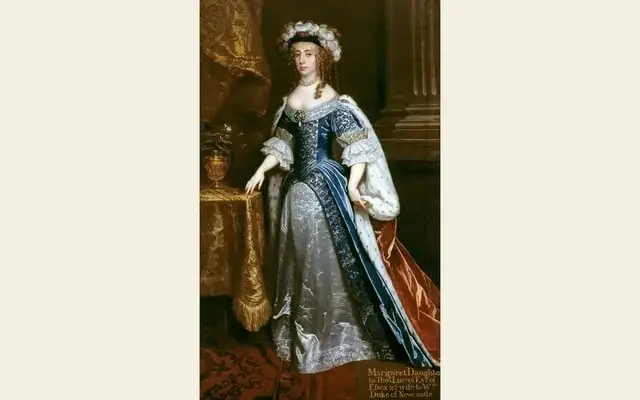
Portraits added another form of authorship in public. A Royal Society collection record describes a seventeenth-century engraved image in which Cavendish stands in a niche, accompanied by classical figures and a poem praising her intellect. This is a different object from Peter Lely’s painted portrait reproduced with this article. Both remind viewers that an author’s image was constructed and circulated alongside words. Dress, pose, inscription, and framing supplied claims about status and learning. A portrait can preserve evidence of those claims without serving as an unfiltered window into the sitter’s private thoughts.
The visit of 1667 consequently belongs within a broader history of making ideas present. Experiments staged in a meeting, a philosophical objection, an invented world, a portrait, and a donated volume reached audiences through different channels. None can replace careful reading of the others. Cavendish’s importance does not depend on pretending that a single invitation gave her equal institutional standing. Her publications and their material traces show an author developing several ways to intervene in discussion. Following those traces allows her arguments, rather than the novelty of her appearance alone, to become the center of the story.