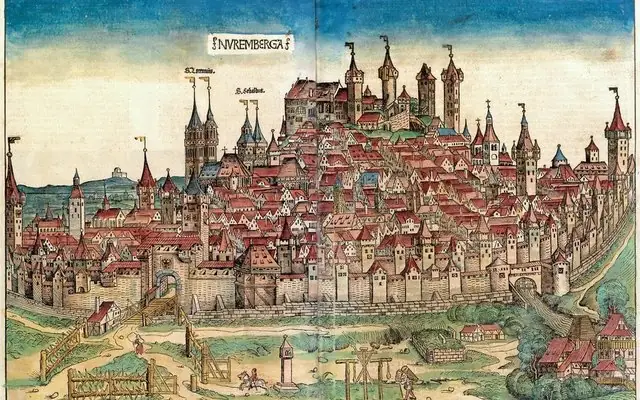
A world arranged on the printed page
A reader opening the Nuremberg Chronicle encounters a world arranged through words and pictures together. Towns rise above their walls, biblical scenes interrupt the columns of text, and figures occupy carefully organized spaces on the page. Published in 1493, the book is known in Latin as Liber chronicarum and is associated with the physician and humanist Hartmann Schedel. Its ambition was to gather a history of the world into a single substantial volume. Understanding it begins with that ambition, but the surviving copies also invite questions about the people who financed, made, decorated, and continued to read it.
The scope of its world was shaped by a Christian historical framework. Gonville and Caius College describes a compilation drawing on earlier writers, including Bede, and extending from Creation into the 1490s. The opening leaves give space to the seven days of Creation, while later sections present historical and geographical material about places in Europe and the Middle East. This was a particular arrangement of knowledge, rather than a neutral survey assembled according to modern historical rules. Its choices tell readers about the ways learned Europeans connected sacred narrative, inherited authorities, and the places they understood themselves to inhabit.
The people behind the publication
Producing such a volume required more than an author at a desk. Trinity College Dublin’s account emphasizes the collaboration between Schedel, the merchants Sebald Schreyer and Sebastian Kammermeister, the printer Anton Koberger, and the artists Michael Wolgemut and Wilhelm Pleydenwurff. Merchant backing made a large publishing undertaking possible, while the printing shop brought text and illustrations into a repeatable form. The resulting book connected several kinds of expertise. A history carrying one compiler’s name could also express the interests and resources of a wider group of citizens in the imperial city where it was made.
The scale of the pictures is striking, but counting them requires care. Chetham’s Library records 1,809 printed illustrations made from 645 different woodcuts. Repetition made the total larger than the number of separate designs. The same portrait could serve different bishops or saints; a city image could reappear for another place. A reader should consequently ask what a particular picture is doing before treating it as an individually observed likeness. Its role might be to identify a category or establish a recognizable visual rhythm, rather than preserve the unique appearance of every person or town it accompanies.
Pictures, language, and finishing by hand
That does not make the images incidental. Trinity’s discussion draws attention to the way the book merges pictures with its text. Turning a leaf changes the balance between a dense passage, a large view, and a sequence of smaller figures. Such arrangements let the page offer several points of entry. Readers could follow the narrative, inspect a scene, or recognize the kind of information being presented. Looking at a digitized page today still makes this physical organization visible. The history of the publication includes the decisions that made its considerable contents navigable as an illustrated object.
Printing also left room for work done by hand. The Folger Shakespeare Library’s account of a surviving copy describes woodcuts colored with inks and paints. It places the Latin publication before a German edition issued later in the same year, showing the project reaching readers through more than one language. Color added another source of variation among individual volumes. A black printed outline and a hand-painted surface belong to connected stages of production, but they should not be confused. Two copies from the same publication can preserve different choices about finishing and presentation.
Readers continue the record
Readers could alter the text’s future as well as its appearance. Chetham’s copy contains extensive annotations, many associated with Thomas Gudlawe around 1590. Notes and additions drew on later works and carried the narrative into the Reformation era. Chetham’s records buying this volume in 1670 for fifteen shillings. The passage from early reader to institutional collection gives the book a history beyond its printing. Margins that might first appear to interrupt a finished work instead preserve evidence of someone using, extending, and arguing with the knowledge already on the page.
The Chronicle survives as both a publishing achievement and a collection of particular objects. Its compiler supplied a learned framework; financial and practical collaborators gave that framework a material form. Translators, colorists, and readers then broadened the range of encounters it could support. No single city view or imposing binding tells the entire story. The most rewarding details often lie in the relationship between a repeated picture and its new label, or between a printed passage and a handwritten addition. An ambitious history of the world became a continuing record of how people handled historical information.