A business behind the stone
A Georgian ornament might look as if a sculptor had patiently cut every curl of a leaf from limestone. Some of the most resilient examples actually began as a ceramic mixture pressed into a mold and fired in a kiln. Eleanor Coade turned that possibility into a flourishing manufacturing business. Her name survives in Coade stone, a material that connected skilled modeling with repeatable production. Its story is about the organization of a workshop as well as the ingredients of a recipe: an attractive design had to emerge from the furnace intact, then persuade an architect or customer to order it.
Born in Exeter in 1733, Coade had already sold linen in London before entering this different trade. In 1769 she took over an artificial-stone concern in Lambeth associated with Daniel Pincot. Their arrangement did not last. By 1771 Pincot had been dismissed, and Coade made her authority over the business explicit. The National Trust preserves her response to his presentation of himself as proprietor: contracts and financial dealings required her agreement. The episode gives a particularly clear view of ownership. Behind objects carrying a woman's name stood a woman determined to control the enterprise that supplied them.
The skill in repeatable ornament
Artificial stone itself was not a new invention. Historic England distinguishes Coade's achievement from earlier attempts: the formulation and manufacturing process produced consistent shrinkage during drying and firing, reducing cracks and distortion. Scientific examination much later identified a mixture including ball clay, previously fired crushed clay, quartz and glass. Several days in a very hot kiln transformed the material into a tough ceramic with a stone-like surface. Explaining the product solely as a mysterious secret misses this practical difficulty. Reliable manufacture required control over what happened between a soft model, a mold and the finished architectural piece.
Design was another essential part of the process. Coade employed accomplished artists, notably the sculptor John Bacon, rather than treating ornament as an incidental addition to a useful substance. A modeled original could provide a mold from which multiple examples were made. Customers could commission individual works or choose from a large catalogue of decorative elements, including panels, capitals, urns and figures. Repetition did not eliminate skilled work; it distributed that work across many objects. It also changed the economics of decoration. A designer could plan repeated classical details without paying for every example to be separately carved from natural stone.
Classical taste meets a showroom
The timing suited a taste for elaborate classical buildings and gardens. Architects including Robert Adam, John Soane and James Wyatt used Coade products. Familiar antique shapes could be adapted to a new setting, while manufactured ornaments traveled beyond the workshop's immediate neighborhood. English Heritage describes Coade vases at Chiswick House based on celebrated ancient examples; their appeal rested partly on their recognizable classical ancestry. The material's flexibility mattered as much as its resemblance to stone. A garden figure, an architectural relief and a decorative vase could all belong to the same commercial range while serving quite different spaces and audiences.
Selling those possibilities required places and people as well as production. In 1799 Coade entered a partnership with her cousin John Sealy, and the firm opened Coade's Gallery near Westminster Bridge to display its products. Sealy died in 1813. Coade remained associated with the business until her own death in 1821. Her customary title, Mrs Coade, can mislead a modern reader: she did not marry, and the title was used by unmarried businesswomen. It should not be used to invent a husband behind the factory. The surviving business history identifies her own sustained direction of the enterprise.
Reading the objects that survive
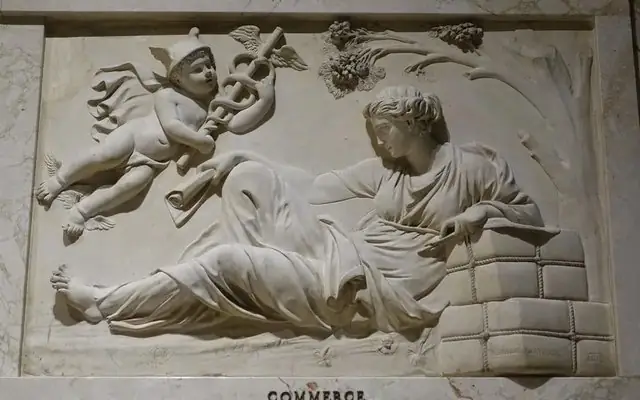
Individual objects make that history more precise. The National Trust's six caryatids at Anglesey Abbey include three signed and dated 1793. Its catalogue says they probably belonged to a group used by Soane at Buckingham House in London. That qualification is part of the evidence, rather than an inconvenience to remove from the story. Dates, stamps, surviving catalogues and records of a building's alterations help establish where manufactured sculpture began and how it moved. The accompanying photograph shows a different factory work, Commerce, dated 1819 and now in Montreal; it illustrates the firm's output, not Coade's likeness or a proven personal act of modeling.
Durability gave the business an unusually visible afterlife, although durable does not mean indestructible. Historic England notes problems including weather exposure, failed joints, corroding metal fixings and unsuitable earlier repairs. Surviving pieces still need informed care. Coade's factory also continued after her death, so a later product bearing the name cannot automatically be treated as work made during her lifetime. Her achievement remains substantial without that confusion. She combined materials, artists, manufacturing discipline and commercial authority, helping to fill buildings and landscapes with ornament whose apparent solidity conceals a history of molding, firing and organized human skill.