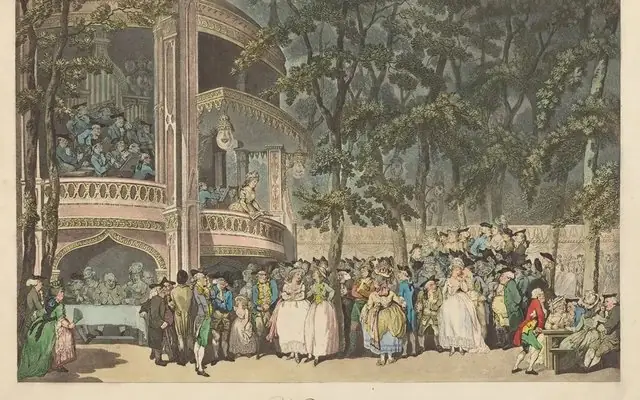
An audience placed on display
At Vauxhall Gardens, an evening's entertainment included watching other visitors enjoy themselves. People could stroll beneath trees, listen to music, examine pictures, and eat in view of a fashionable crowd. The setting turned the public into part of the spectacle. Yale's exhibition of eighteenth-century garden prints emphasizes that theatrical relationship: the audience appeared on display alongside the performers. Vauxhall offered more than a concert transplanted outdoors. It arranged several pleasures within one designed environment, allowing an ordinary movement along a path or a pause beside a supper table to become a social performance.
Jonathan Tyers's improvements gave that performance an architectural setting. Contemporary engravings show the orchestra building, triumphal arches, covered supper boxes, and a statue of the composer Handel. Painted landscapes at the ends of walks extended the apparent views through visual illusion. Yale identifies these devices as elements in a highly theatrical garden. They guided attention while making a bounded commercial property seem more expansive. Visitors encountered a landscape built to be looked at, but they also entered its composition themselves. Moving through the gardens meant repeatedly passing between the roles of spectator and visible participant.
A composer became part of the scenery
The statue of Handel made the connection between art and entertainment especially clear. Commissioned by Tyers and installed in the gardens in 1738, Louis-François Roubiliac's marble presented a living composer on a scale usually reserved for powerful public figures. The Victoria and Albert Museum describes Handel in informal clothing, holding a lyre and resting beside scores. This was not simply a label telling visitors whose music they might hear. It gave musical celebrity a physical presence inside the grounds, joining a popular composer's reputation to the identity of the place that displayed him.
The V&A also interprets Tyers's artistic commissions as an attempt to improve the gardens' reputation. Paintings decorated dining booths, while sculpture stood among the avenues. Refined culture could help market a venue whose evening gatherings also attracted suspicion about sexual behavior and disorder. Those ambitions did not eliminate the tension. Respectable appearances and the excitement of a less controlled meeting place could coexist. Vauxhall's appeal depended partly on that mixture: visitors entered somewhere carefully arranged by an entrepreneur, yet social encounters within the arrangement could not be scripted as neatly as an ornamental view.
Supper under public eyes
Eating helped make an evening last, and it kept customers within the setting. London Museum describes Vauxhall's open-air supper boxes arranged around the center, where visitors ordered meat, bread, wine, and sweets. These booths offered some enclosure while leaving diners exposed to the wider garden's gaze. A meal could therefore be both a private group's occasion and a public display. The combination mattered in a city where many existing eating places served travelers or predominantly male customers. Vauxhall made refreshments part of going out for pleasure, alongside music, scenery, and the company nearby.
The food's reputation was less generous than the surroundings. London Museum records small portions and high prices, including a shilling for a slice of ham or beef in 1762. That was also the stated entrance charge; an inexpensive meal elsewhere could cost less. Visitors were buying a position within an entertainment environment as much as a quantity of food. Complaints about thin meat and costly refreshments became part of the shared experience. The joke reminds us that commercial leisure involved ordinary calculations too: an impressive evening could still leave a customer wondering what dinner had actually been worth.
The price and changing form of public pleasure
Calling the gardens public does not mean that every Londoner could participate. London Museum stresses that the admission fee excluded many people, even while those who paid could mingle beyond the boundaries of a private invitation list. Clothes, manners, and spending helped shape the crowd inside. The gardens made certain forms of sociability available through purchase, but they did not remove the city's inequalities. This is a more revealing distinction than treating Vauxhall as either an aristocratic enclosure or a completely democratic park. Its audience was broader than a household gathering, yet access still had a price.
The formula also had to change as London's entertainment market developed. In the nineteenth century pleasure gardens offered balloons, acrobatics, popular songs, and fireworks while competing with other venues for audiences. Vauxhall eventually closed in 1859. Its eighteenth-century achievement nevertheless remains visible in surviving views and objects: a landscape, a musical program, works of art, and dining could be sold as a combined night out. The visitor's experience depended on their connections. What made the gardens memorable was not one attraction alone, but the pleasure and uncertainty of becoming part of the crowd around it.