Furniture with a second occupation
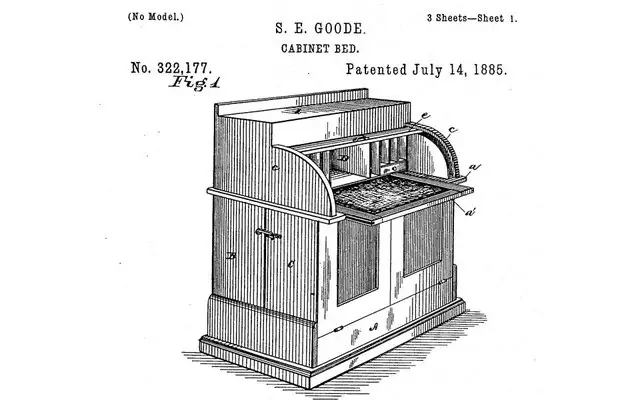
A desk with compartments for papers and a place to write might appear to be an ordinary item of nineteenth-century furniture. Sarah E. Goode designed one that could change its occupation at bedtime. Her cabinet bed opened into a sleeping place and folded back into a useful desk. United States patent 322,177, issued on July 14, 1885, records the proposal in drawings and a detailed description. The object is amusing to imagine, but the underlying problem was serious: a room could need to accommodate activities for which there was not enough space to keep separate furniture permanently spread out.
The patent identifies Goode as a citizen living in Chicago, Illinois. The National Archives' educational presentation describes her as a furniture-store owner responding to customers who lived in small apartments. That connection helps explain the appeal of the invention without requiring an invented moment of inspiration. Furniture occupied valuable floor area, and an unused bed remained a large object during daylight hours. A convertible piece promised to make the same footprint serve different purposes. The design addressed the organization of daily life as directly as a more conspicuous machine addressed a factory process.
A transformation that had to work
Goode's description sets out four practical objectives. The folded bed should become a desk; its moving sections should be easier to lift; they should remain secure when extended; and the middle of the bedding should receive support automatically. These requirements show the distance between a clever idea and usable furniture. Saving floor space was only one consideration. A person also needed to open the object without fighting its weight, sleep on a stable structure, and close it again. The invention treated those ordinary actions as engineering problems worth solving together.
The drawings make the transformation easier to follow. A central frame remained stationary while sections hinged from opposite sides opened into the ends of the bed. The writing furniture belonged to the head section, with storage for papers and supplies. The result was more ambitious than hiding a bed behind decorative panels. The closed object could perform another useful task. Reading the views together, rather than looking only at the most attractive perspective drawing, reveals a design intended to move between states. Its identity depended on what the user needed at a particular time of day.
What a patent can establish
A patent is also a particular kind of historical evidence. It records a named person's claim to an invention and explains the arrangement being protected. It cannot, by itself, demonstrate how many examples were manufactured or how much money they earned. The National Archives preserves a fuller file containing drawings, specifications, amendments, and correspondence. That combination matters because it makes the inventor visible through a working administrative record. A careful account can admire the design while leaving sales figures and commercial triumphs unstated when the cited documents do not establish them.
Goode is often introduced as the first African American woman to receive a patent. Accounts differ, and the broader record of early Black women patentees makes an unqualified ranking unreliable. Her achievement does not depend on that contest. Leila McNeill's Smithsonian discussion places domestic inventors within a society where racism, restricted education, and limited professional opportunities constrained recognition. The useful question is what work became possible despite those obstacles, and what evidence survives. Goode's name appears on a document describing a specific contribution, something more substantial than a position in a simplified list of firsts.
Domestic problems belonged to invention
McNeill also draws attention to how easily domestic technology disappears from familiar stories of invention. A household object can require design, experimentation, and mechanical understanding even when its purpose seems ordinary. Goode's cabinet bed makes that point especially clearly because it joins writing and sleeping in the same structure. Neither activity needed to be new for their combination to demand ingenuity. The invention invited users to reorganize a limited interior instead of accepting that every function required its own permanently occupied space. Its small scale did not make the problem insignificant to the person living there.
The surviving patent drawing is therefore a better starting point than an imagined portrait of a lone genius at work. It shows furniture that changes shape, carries storage, and promises to fit several uses into one room. The accompanying description gives Goode an authorial voice within the technical record. Her cabinet bed belongs to the history of invention because it takes a familiar inconvenience seriously and proposes a concrete arrangement of parts. A desk becoming a bed was a small domestic transformation, but it preserved a woman's claim to having thought carefully about how that transformation should happen.