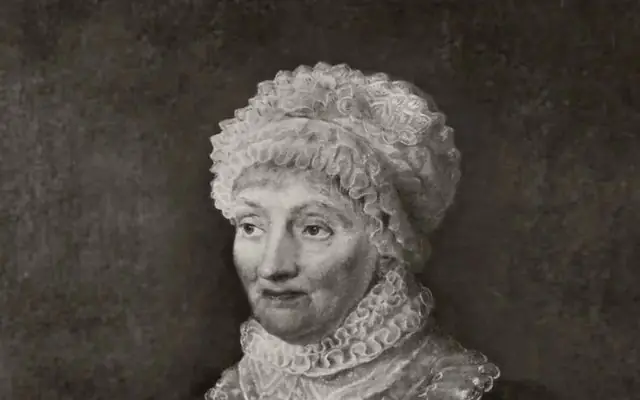
A discovery becomes a document
On the night of August 1, 1786, Caroline Herschel found an unfamiliar object while searching the sky. It became the first of eight comets she discovered or independently rediscovered over the following eleven years. The Royal Society preserves her report, dated the next day, as a small manuscript with a plate and an accompanying note from her brother William. That surviving paperwork is a useful introduction to her career. Seeing something through a telescope was the beginning; recording its position and communicating it made the observation available to a wider scientific world.
Caroline was born in Hanover in 1750 and joined William in Bath in 1772. Astronomy was not originally the profession that brought them together. He worked as a musician, and she trained as a singer, eventually appearing in concerts. Their household nevertheless became increasingly occupied by mirrors, tools, and observations. The Herschel Museum places their story inside an ordinary Georgian house where musical and astronomical careers overlapped. After William discovered Uranus in 1781, royal support helped turn his observing into a full-time occupation, and their working lives moved toward the Windsor area.
Observing was only part of the work
Her contribution involved much more than standing beside an instrument. Royal Museums Greenwich describes her recording measurements, helping grind mirrors, performing calculations, and managing household work. These tasks connected the practical construction of a telescope with the mathematical processing of what it revealed. An observation called out in darkness could be lost or made ambiguous without a reliable written record. Later calculations gave those notes a form that could be compared with other observations. The partnership's scientific output therefore depended on work done away from the eyepiece as well as on clear nights outdoors.
William also provided her with a telescope suited to searching for comets. Such searching involved methodical sweeps rather than waiting for an obvious spectacle to announce itself. Caroline's own discoveries developed alongside the demands of assisting him. The Science Museum Group records both her comet work and her contributions to the study of nebulae, objects that appeared as misty patches in contemporary instruments. Her report of 1786 went into the Royal Society's publication system, showing that her observations could circulate under her own name even within a career structured around a family collaboration.
A salary and a catalogue
In 1787 she received an annual royal salary of fifty pounds as William's assistant. Her recollections explain its personal significance with unusual directness. Although she had long handled household expenses, money allocated for her own needs had still belonged within her brother's accounts. The salary gave her an income she regarded as hers to spend. It was a modest institutional arrangement with a large private meaning. Recognition of scientific labor appeared here as a quarterly payment, changing her relationship to work she was already doing and to the household that depended on it.
Catalogue work supplied another route to discovery. Caroline cross-referenced and corrected John Flamsteed's earlier stellar observations, producing an index and additions published in 1798. The European Space Agency describes hundreds of stars restored to the usable record through that effort. A catalogue may sound less dramatic than a newly noticed comet, but its purpose was practical: astronomers needed to identify objects consistently and find their way among earlier observations. Correcting an omission or making a scattered record searchable could save another observer time and prevent an old observation from being mistaken for something entirely new.
Useful records across generations
After William died in 1822, Caroline returned to Hanover and continued organizing astronomical material. Her work on the nebulae catalogues assisted the next generation, including her nephew John Herschel. In 1828 the Royal Astronomical Society awarded her its Gold Medal; in 1835 it elected her an honorary member alongside Mary Somerville. The memoir and correspondence preserve these honors together with letters and working memories. They reveal a career that continued beyond the end of the best-known sibling partnership, sustained by the value of records already accumulated and still needing careful arrangement.
Caroline died in 1848, aged ninety-seven. Her legacy is often condensed into a sequence of female firsts, but the surviving work offers a fuller picture. Concert training, instrument making, night searches, arithmetic, correspondence, and cataloguing all entered the same career. A comet could attract immediate attention; an organized catalogue could remain useful long afterward. Following both activities makes her achievement easier to understand. She helped enlarge the known sky while also making observations easier for other people to recover, compare, and use.