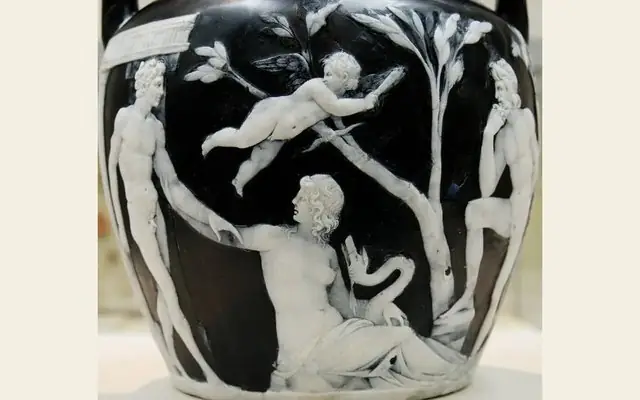
A famous survival becomes a puzzle of fragments
On 7 February 1845, an object already celebrated for surviving antiquity was smashed inside the British Museum. A visitor struck the display containing the Portland Vase with a piece of sculpture, breaking the glass vessel and its case. The attack transformed a famous Roman artwork into a problem of fragments. John Doubleday reconstructed it soon afterward, but that was not the end of its restoration history. The vase's survival would depend on patient repair, changing adhesives, and an unexpected resource: copies made by people who had once wanted to possess something resembling the original.
The vase belongs to the early Roman imperial world, although scholars have proposed different dates and interpretations. Its dark blue glass carries a contrasting white layer carved into figures and landscape details. The result resembles a large carved gemstone wrapped around a vessel. Knowing how to describe that effect does not settle what the pictures mean. Princeton University Art Museum summarizes competing readings, from the marriage of Peleus and Thetis to imagery associated with Augustus and divine ancestry. These are proposals about an enigmatic scene, not an ancient caption whose meaning has simply been recovered.
Copies that recorded an earlier condition
Long before the museum attack, copying had become part of the vase's biography. The British Museum preserves a plaster version made from a mould taken in 1783. Its record identifies James Tassie as the maker and Giovanni Pichler as the creator of the original mould, commissioned while the dealer James Byres owned the glass vase. The plaster body was assembled in sections, and the cast records damage already present before 1845. A reproduction therefore carries more than a likeness. It can preserve the condition of an object at a particular moment, including features later repairs might make harder to see.
Josiah Wedgwood pursued a more demanding translation into ceramic. In 1786 he began a project to reproduce the vase in jasperware, the fine stoneware his factory had developed. Dark clay supplied the background; separately modeled white figures were applied to it. This reversed the visual logic of the Roman object. Where the glass cutter removed material to reveal a design, the potter added reliefs to a clay body. Making the results look alike required mastery of processes that were fundamentally different, and an admired ancient surface became a test of contemporary manufacturing.
Failures preserved beside the finished vases
Surviving trials at the V&A Wedgwood Collection expose how difficult that test was. Gas expanding inside the clay produced bubbles in one experimental vase; in another, delicate reliefs failed to adhere and broke away during firing. Factory records and unfinished examples preserve the setbacks behind the polished copies. By 1790, versions were ready for subscribers. Even the unevenness of the ancient handles was carefully studied. The project sought a convincing resemblance, but its failures made clear that an outline and a set of moulds were not enough to control what happened inside a kiln.
The copies also traveled through friendships, exhibitions, and trade. The Corning Museum of Glass traces a successful ceramic example sent to Erasmus Darwin in 1789, with a request that he limit who saw it. Darwin did not keep that restriction. His later Botanic Garden included discussion of the vase and engravings by William Blake. Wedgwood's son took a version around Europe to seek further buyers. The ancient vessel was becoming a network of other objects and printed images, reaching people who might never stand before the glass itself. Its reputation multiplied through material translation.
Restoration becomes part of the history
That multiplied record acquired another significance after the disaster. Reconstruction could return the shape without freezing its condition forever. Milo Keynes's study in the Royal Society's Notes and Records follows later repairs, including a twentieth-century dismantling to remove discolored glue and another reconstruction in 1988–1989. Adhesives that once made an object legible could themselves become a problem. Restoration was therefore an ongoing historical process, not a single triumphant reversal of breakage. Reassembling the vase required decisions about joins, missing areas, and the visibility of interventions made by earlier hands.
Princeton's account notes that a Wedgwood copy helped guide restoration after the 1845 attack. The copy had begun as an ambitious product; circumstances gave it the additional role of evidence. That does not make every replica an exact record, or resolve the mysteries of the ancient figures. It shows why an artwork's afterlife can matter to its physical survival. The Portland Vase belongs simultaneously to Roman glassworking, Georgian ceramic manufacture, collecting, and conservation. Its many descendants are part of that history: they helped spread its fame and preserved information about a fragile object whose continued existence could never be taken for granted.