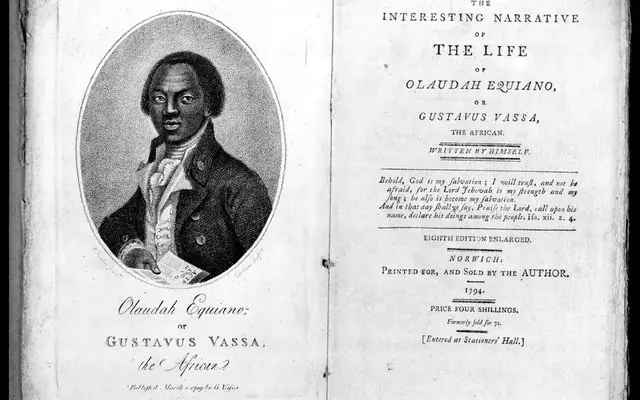
An author claiming his own life
The title of Olaudah Equiano's autobiography announced both a life and a claim to authority. Published in 1789, The Interesting Narrative of the Life of Olaudah Equiano, or Gustavus Vassa, the African identified its author by two names and insisted that he had written it himself. A formerly enslaved man was presenting a considered account of his experiences to a reading public that often encountered Africans as objects of trade or subjects of other people's descriptions. The book made an individual voice part of the argument against the slave trade, while asking readers to recognize the author's intellectual independence.
The beginning of that life remains disputed. Equiano described an Igbo childhood at Essaka in what is now Nigeria, followed by kidnapping and enslavement. Oxford's Faculty of English explains that historian Vincent Carretta identified evidence suggesting a South Carolina birthplace instead. The British Library likewise notes that historians disagree. A responsible reading therefore distinguishes the childhood story told in the autobiography from an independently settled birthplace. The uncertainty matters to how particular passages are interpreted; it does not turn the book's documented publication or Equiano's subsequent public antislavery activity into uncertain events.
Freedom inside an Atlantic working world
His years under slavery took him across an Atlantic world of ships, military service, and commerce. The British Library describes his employment aboard vessels controlled by Robert King in the Caribbean, where small-scale trading helped him accumulate the money required to purchase his freedom in 1766. That achievement did not make freedom secure everywhere. As a free seaman he still faced violence, fraud, and threats of being enslaved again. The distinction between possessing freedom and being able to exercise it safely became part of the wider experience his narrative brought before British readers.
The autobiography was consequently more varied than an account of captivity alone. It included travel, sea voyages, commercial encounters, and a developing Christian faith. The British Library treats it as a political work, a travel narrative, and a conversion story as well as a life history. These forms did not compete for a place inside the book; their combination helped establish a thinking, changing person. Equiano could describe the labor and danger of maritime life while examining his own beliefs. The reader encountered an author whose concerns extended beyond the identity that enslavement had tried to impose on him.
The public machinery of a personal book
The printed book also reveals the work of reaching an audience. Its title page identifies it as printed for and sold by the author, then lists London booksellers through whom copies could be obtained. A substantial subscriber list includes aristocrats, clerics, merchants, women, and named purchasers of multiple copies. Ottobah Cugoano, another Black antislavery writer, appears there too. These pages make publication visible as a network of transactions and commitments. The memoir did not move from private recollection into public influence automatically; it had to be financed, distributed, bought, and read.
Before the narrative proper, Equiano addressed Britain's Lords and Commons. The dedication is dated March 24, 1789, and presents the book as an appeal concerning people suffering under the slave trade. Its formal deference sits beside a clear political purpose. The autobiographical speaker was directing attention toward a decision that legislators could make, not merely requesting sympathy for a completed personal ordeal. Reading the dedication alongside the subscriber list shows two related audiences: those who might support and circulate the publication, and those whose institutional power could help change the system it described.
A book within a larger campaign
His campaigning extended well beyond the printed volume. Parliament's Heritage Collections account records Equiano attending Commons debates in 1788, publishing letters aimed at government, and corresponding with politicians. A letter to Lord Hawkesbury was presented as evidence to a parliamentary committee in 1789. He also toured to discuss his book and the abolition cause. These activities complicate the familiar picture of a memoir speaking entirely for itself. Equiano placed the work inside an organized public campaign, moving between readers, meetings, correspondence, and the procedures through which political evidence could be heard.
Equiano died in 1797, before Parliament prohibited the British slave trade in 1807. That measure did not immediately free everyone enslaved in Britain's empire; ending the trade and ending slavery were distinct struggles. His book belonged to a larger movement, and it would be misleading to credit one author with accomplishing its eventual legal changes alone. What survives is a particularly powerful intervention within that movement. A person once treated as property became a publisher, witness, and political correspondent, using the material form of a book to insist that his experience deserved public attention.