A classroom that challenged expectations
Opening a school could mean challenging much more than an absence of classrooms. When Savitribai Phule and Jyotirao Phule began a school for girls in Pune in 1848, they confronted expectations about whose knowledge mattered and who should receive it. Savitribai became a teacher in a project that linked education with opposition to caste exclusion and the restrictions imposed on women. The school associated with Bhide Wada offered subjects including mathematics, science, and social studies. Its significance lay not simply in assembling pupils, but in treating girls as people entitled to a serious intellectual education.
Savitribai had first needed access to learning herself. Born in Naigaon in 1831, she married Jyotirao while still a child and received education at home after their marriage. Hari Narake's account published by India's National Council of Educational Research and Training draws on an educational report and contemporary journalism to describe that beginning. It also records further instruction and teacher training connected with Ahmednagar and Pune. Her movement from learner to teacher was therefore a process of preparation. It depended on assistance and opportunities that she would later help extend to others.
Making access more than a promise
Keeping a school open required more than announcing that its doors were available. An educational account published through INFLIBNET describes Savitribai using stipends to reduce the risk of children leaving school and organizing meetings with parents. These measures addressed the practical circumstances around attendance. A family might need convincing that schooling justified the time a child spent away from other responsibilities. Financial support and conversation with parents made an educational principle into a continuing relationship. The teacher's work reached beyond lessons because the barriers facing her pupils also existed beyond the classroom.
The same account places her teaching within an educational philosophy shared with Jyotirao: knowledge should be useful, intellectually questioning, and connected to social change. Their concern with primary education challenged a hierarchy that assigned greater standing to more advanced institutions and their teachers. Practical subjects appropriate to pupils' lives mattered alongside literacy. Learning could help a child examine an assertion rather than merely repeat it. That expectation made education politically consequential. If inherited authority depended on unquestioned acceptance, a school that encouraged reasoning could disturb the assumptions through which inequality reproduced itself.
Words and practical assistance
Savitribai also addressed readers through poetry. Her collection Kavya Phule appeared in 1854, followed by Bavan Kashi Subodh Ratnakar in 1892. The National Book Trust's biographical account emphasizes how her writing urged oppressed people to seek liberation through education. Poetry carried that argument into another form, connecting the acquisition of knowledge with dignity and independence. She was not only someone whose life could illustrate a reformer's ideas. She produced words of her own, offering a public voice alongside her daily work as an educator and organizer in nineteenth-century Maharashtra.
The educational campaign formed part of wider efforts to protect people harmed by social conventions. Institutional accounts describe the Phules establishing a home for women and infants whose circumstances exposed them to stigma and danger. Its name, Balhatya Pratibandhak Griha, expressed opposition to the killing of children. Providing care answered a problem that condemnation alone could not solve. A person facing exclusion needed somewhere to go, just as a child denied education needed a functioning school. The parallel helps explain why their reforming activity crossed boundaries between teaching, family life, and organized assistance.
Equality at a well and a clinic
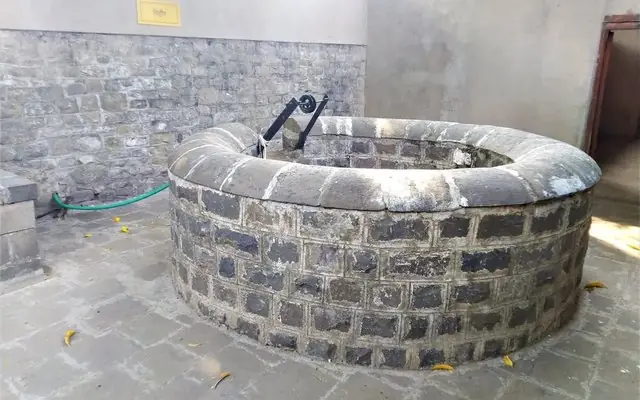
A well offered another direct test of the same principle. In 1868 the Phules opened access to their household well to people excluded by caste practices. A source of water was an ordinary part of domestic infrastructure, yet the decision about who could approach it carried an extraordinary social weight. The modern well preserved at Mahatma Phule Wada makes that aspect of their work easier to visualize. It is a reminder that reform concerned repeated everyday actions: entering a classroom, drawing water, or finding shelter could all reveal where an assertion of equality met an enforced boundary.
Savitribai's service continued during the plague epidemic in 1897. The National Book Trust records that she and her adopted son Yashwant established a clinic near Pune, and that she contracted plague while working to help patients. She died that year. Her life cannot be reduced to a single first or commemorative title. Its force lies in the connections among learning, writing, practical support, and resistance to exclusion. The school was an important beginning, but her wider work kept asking what conditions had to change before people could actually use the opportunities they were promised.