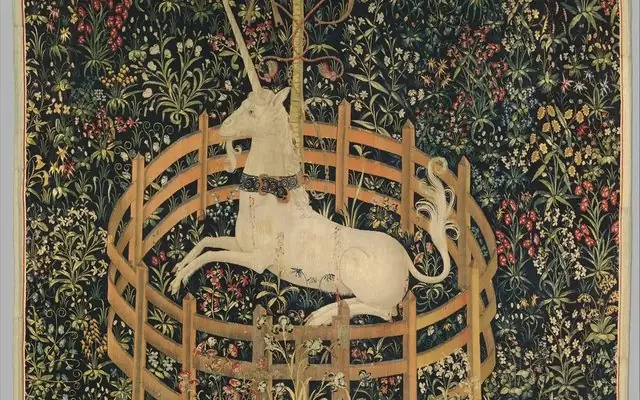
A fence the unicorn could escape
A white unicorn sits inside a little circular fence, surrounded by so many flowers that the dark ground almost disappears. A chain connects its ornamental collar to a pomegranate tree, yet the barrier looks surprisingly easy to cross. The Metropolitan Museum of Art interprets this famous hanging as an image of willing confinement: a beloved creature content to remain where it is. That small puzzle makes The Unicorn Rests in a Garden more than a charming medieval animal picture. Even before we ask who commissioned it, the tapestry asks whether captivity might be another name for attachment.
The museum dates the work to 1495–1505 and identifies French designs translated into weaving in the Southern Netherlands. Its pomegranates supply an important clue to one possible meaning. Their crowded seeds were associated with fertility and marriage, while several surrounding plants carried similar reputations. Red marks on the unicorn's body need not represent wounds; the museum's current interpretation identifies them as juice falling from the fruit. These are historical beliefs embedded in an artwork, rather than evidence that the plants possessed the reproductive powers once attributed to them.
A garden built from thread and dye
The persuasive garden was built from threads. Plain wool formed the stretched foundation, or warp, while dyed wool, silk, silver, and gilded threads supplied the weft passing across it. The resulting surface could imitate substances very different from itself. Elsewhere among the Unicorn Tapestries, hunters wear costumes whose woven details suggest velvet, leather, fur, and brocade. The skill lies partly in this transformation: the same basic process makes soft clothing, a bright animal, hard weapons, and delicate leaves appear to belong to one continuous world.
Color also had a material history. Chemical analysis has identified three important plant dyes in the group: weld for yellow, madder for red, and woad for blue. Combining colors and using mordants to help fix dyes to fibers expanded the range available to the weavers. Metallic threads added highlights that ordinary yarn could not provide. Looking closely therefore changes the question from what the unicorn represents to how so many small decisions made it visible. The apparently effortless meadow required an organized command of materials, chemistry, design, and patient manual work.
A hunt with more than one meaning
Other hangings turn the unicorn into the quarry of a strenuous hunt. One brings two moments together: hunters kill the animal, and a noble couple receives its body outside a castle. This is not a sequence of separate modern frames. Events share a single woven space, allowing a viewer to move between pursuit, death, and presentation. The museum notes possible Christian associations, including thorny branches recalling the Crown of Thorns. It also leaves the receiving couple's identity unresolved. They might be patrons, characters within the hunt, or figures carrying a religious meaning.
The broader legend could sustain such overlapping readings. The Met's 2013 exhibition traced unicorn stories through religious writing, courtly love, travel accounts, and supposed natural history. A maiden's power to subdue the animal could become an image of Christ's incarnation, while the same creature also appeared in celebrations of worldly love. These possibilities do not prove that every viewer saw exactly the same story. They explain why a magnificent hunting image could carry meanings beyond the pleasure and prestige of the chase, and why one confident translation into a single message would be misleading.
Owners recorded long after the weaving
The objects' ownership is firmer only much later than their manufacture. They are documented in the Paris home of François VI de La Rochefoucauld in 1680; by 1728, five were recorded in a bedroom at the family's château at Verteuil. Looted during the French Revolution, the tapestries were recovered in the 1850s and restored. Their original commission remains undocumented. A recurring cipher containing the letters A and E has encouraged efforts to identify the first owners, but it has not supplied an agreed answer. Differences between the hangings also raise doubts about whether they began as one set.
John D. Rockefeller Jr. gave the tapestries to the Met in 1937, before The Cloisters opened the following year. Their museum arrangement now encourages visitors to connect the hunt with the resting unicorn, but the garden hanging may originally have been an independent image. That uncertainty is part of its history. The fence offers a memorable invitation to look again: a creature can seem securely captured while its meaning remains free to move. We know the materials, can follow portions of the ownership record, and can compare interpretations without pretending that the missing commission has finally been found.