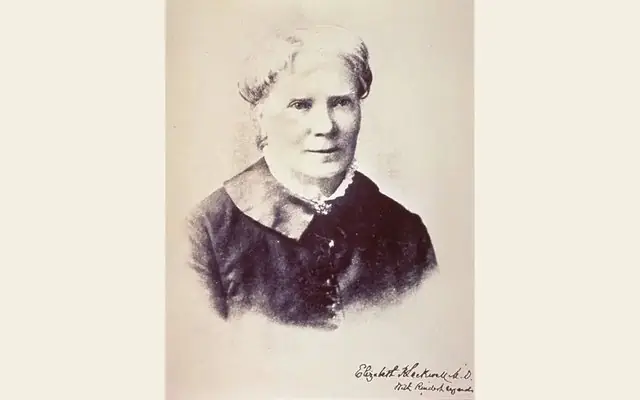
A diploma with an unfinished task
On January 23, 1849, Elizabeth Blackwell received her medical diploma at a crowded church in Geneva, New York. An eyewitness account preserved by Hobart and William Smith Colleges describes her approaching the platform after the other graduates, then joining them amid applause. It was a public conclusion to an education many people had considered impossible. Yet the ceremony solved only one part of her problem. Possessing a qualification would not automatically bring patients, hospital appointments, or colleagues willing to consult with a woman physician. The longer story began where the famous graduation scene ended.
Blackwell was born in Bristol in 1821 and moved to the United States with her family as a child. After her father's death, teaching helped support the household. Medicine was not an ambition she recalled having from earliest childhood. According to her own later account, a dying friend suggested that the presence of a female doctor might have eased her suffering. Blackwell gradually transformed that suggestion into a plan. The National Park Service describes the advice she encountered: established doctors told her that admission, graduation, and an actual practice would all be beyond reach.
An education still had to be negotiated
Her application to Geneva Medical College succeeded in 1847, following refusals elsewhere. The National Library of Medicine recounts the unusual vote behind the decision: the faculty passed the question to the male students, who agreed to admit her while treating the proposal as a joke. Whatever the intention of the vote, a real student arrived. Access still had to be negotiated. The National Park Service notes that Blackwell initially faced exclusion from surgical demonstrations. Being accepted into an institution and receiving the education available inside it were separate questions, requiring more than an acceptance letter to settle.
After earning her degree, she pursued further training in London and Paris. An eye infection contracted during her European clinical work cost her sight in one eye and ended her hope of becoming a surgeon. Returning to New York in 1851 did not produce an easy alternative career. The National Library of Medicine describes a practice with few patients and limited opportunities to exchange knowledge with other doctors. A qualification could certify competence without creating the professional relationships through which a physician continued learning. Blackwell therefore began constructing the setting that existing institutions had refused to provide.
A dispensary built from practical help
In her 1895 autobiography, she described the independent dispensary begun with friends' help in 1853. The enterprise required ordinary arrangements as well as a public argument: a room, medicines, a screen, and dependable opening hours. Her account identifies Quaker supporter Cornelia Hussey among those who helped prepare it. This modest beginning is a useful counterweight to the image of a solitary pioneer. The work depended on subscribers and practical assistance, not just determination. It also connected a doctor's need for clinical experience with the unmet needs of women who could not afford private care.
The first annual dispensary report, reproduced in the autobiography, makes that connection unusually concrete. It describes more than two hundred poor women receiving assistance and gives the weekly afternoons when the service opened. Advice concerned living conditions as well as individual ailments: cleanliness, ventilation, food, and the search for work all entered the report. Some families needed a small loan while looking for employment. These details reveal an institution developing around the circumstances of its patients. They do not establish that every treatment was effective; they show what its organizers thought responsible medical assistance ought to include.
Creating a route for other women
In 1857 Blackwell, her physician sister Emily, and Marie Zakrzewska opened the New York Infirmary for Women and Children. Its purpose included employment and training for women physicians as well as care for poor patients. The National Women's History Museum emphasizes that double mission. Later a medical college expanded the educational side of the work. Rather than allowing her own degree to stand as an exceptional success, Blackwell helped create routes through which others could study and practice. Cooperation among qualified women answered a barrier that a single celebrated graduation could not remove.
Her subsequent career returned her to Britain, where she continued promoting women's medical education and published arguments about professional reform. The National Women's History Museum also records the Blackwell sisters' contribution to training Union nurses during the American Civil War. Across these different settings, her influence rested on the institutions and opportunities built after admission had been won. The diploma remains an important landmark, but the dispensary's afternoon timetable offers another measure of change. A door had become useful only when patients could walk through it and other women could find work on the far side.