A light that could ignite its workplace
The light that let a coal miner see his work could also set his workplace on fire. Before electric lighting, candles and other exposed flames accompanied men into passages where flammable gases escaped from the coal. A dangerous mixture of methane and air, commonly called firedamp, could turn illumination into an ignition source. Humphry Davy's answer in 1815 was strikingly modest in appearance: place the flame inside a fine metal mesh. The resulting safety lamp became an industrial emblem, although the story behind it involves competing inventors, difficult working conditions, and a compromise between brightness and protection.
The demand for a safer light came from mining communities rather than from an abstract laboratory puzzle. The National Coal Mining Museum connects the campaign to the 1812 Felling Colliery explosion, which killed ninety-two men and boys. A society formed the following year to address accidents in coal mines. After approaches to Davy, work began at the Royal Institution during the autumn of 1815, with Michael Faraday assisting him. The problem was unusually unforgiving: the miner needed air to keep a flame burning and enough light to continue working, while the surrounding atmosphere might itself become combustible.
A barrier made from tiny openings
Davy investigated small passages through which a flame would fail to travel. The Royal Institution preserves several stages of the design and describes experiments involving narrow metal tubes and different meshes. In the familiar solution, a cylinder of wire gauze surrounded an oil-fed wick. Air could enter and light could escape, while the metal absorbed heat from a flame trying to pass through the openings. This was a controlled arrangement of fuel, air, and cooling. The important boundary was not a solid wall that excluded the atmosphere, but a finely divided surface across which ignition would not ordinarily propagate.
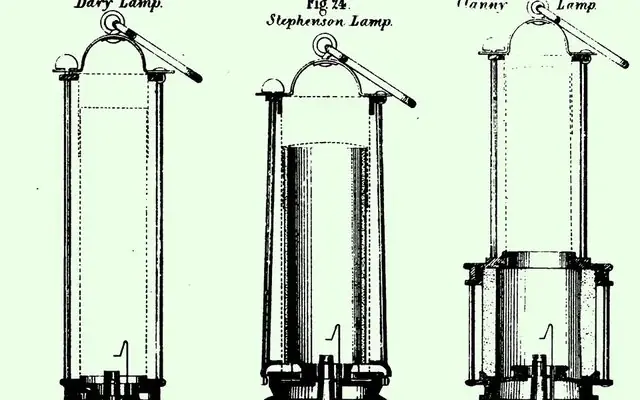
Surviving early lamps make that principle tangible. The Science Museum Group records two Davy lamps dated 1815, distinguishing them from the experimental example preserved at the Royal Institution. Their construction combined an oil reservoir with a gauze cylinder, protective rods, and a carrying ring. One had a larger reservoir and an external filling spout. Such differences matter because an invention reaches a workplace through manufactured objects, rather than through a diagram alone. Reservoirs, fittings, and protection for the mesh determined how the laboratory idea could be carried, replenished, and incorporated into a miner's daily routine.
From laboratory to colliery
Testing then moved from London to a coal mine. The National Coal Mining Museum dates the Hebburn Colliery trials to 9 January 1816 and records that Davy sent five lamps to the northeast. John Hodgson, a clergyman associated with the community affected by the Felling disaster, took part. This sequence helps explain why museum labels can date a lamp to 1815 while accounts of its underground introduction emphasize 1816. Design, manufacture, experimental demonstration, and practical use are separate moments. Compressing all of them into a single invention date hides the work required to establish confidence in a new device.
Davy was not the only person seeking that confidence. George Stephenson, an engineer at Killingworth Colliery, independently developed another safety lamp, and the two men became opponents in a fierce dispute over priority. The Royal Institution's account places their work alongside the independent investigations of Smithson Tennant into narrow passages and flame. These overlapping efforts complicate the familiar picture of a lone scientific hero arriving with a finished answer. They also reveal different routes to technical knowledge: the mining engineer's practical experience and the metropolitan chemist's laboratory experiments addressed an urgent problem that neither profession owned exclusively.
The cost of a safer light
Protection had a visible cost. The National Coal Mining Museum explains that early Davy lamps produced only about a quarter of the illumination of the naked flames they replaced. Its bullseye example, made by London instrument maker John Newman around 1818, used a lens to concentrate light into a brighter spot. That feature was useful for surveying, reading, and observing fine details. The collection therefore preserves more than a victory over firedamp. It shows manufacturers adjusting the balance between a protective barrier and a worker's need to see, an ordinary requirement that could not simply be designed away.
The lamp's wider consequences were equally complicated. According to the Royal Institution, its adoption enabled deeper mining and greater production as well as improving safety. A protective invention could thus reduce one danger while helping an industry expand into new working environments. Its history should not be read as a claim that every later lamp made every mine safe. Instead, the surviving objects expose the practical negotiations inside technological change. Thin wires acquired enormous significance because people learned to make a useful light and a dangerous atmosphere coexist within carefully arranged limits.