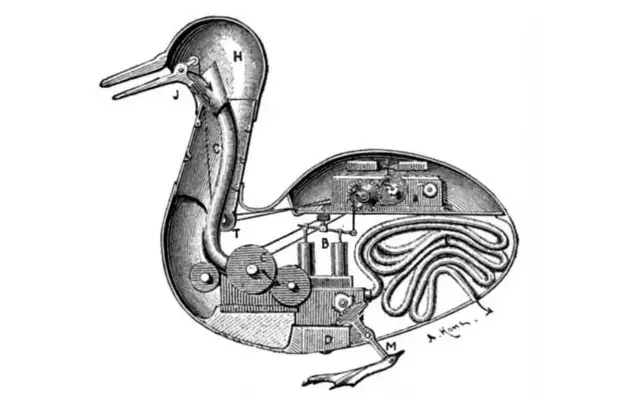
A very unusual mechanical performer
Among the unusual attractions offered to eighteenth-century spectators, Jacques de Vaucanson's mechanical duck had a particularly memorable performance. It took in grain, moved like a bird, and appeared to discharge the result of digestion. Historian Jessica Riskin places its Paris exhibition in the late 1730s, alongside two mechanical musicians. Audiences were paying to watch more than a clockwork ornament. The promise was that mechanisms could reproduce actions associated with living bodies, including processes normally hidden inside them. The duck made that ambitious claim through an activity difficult for any spectator to forget.
Vaucanson advertised his machines in print as well as through demonstrations. A 1742 English translation of his account survives in the Wellcome Collection, translated by natural philosopher John Theophilus Desaguliers from the earlier French publication. Its long title lists the duck's eating, drinking, feather movements, and other imitations of a living animal. The Royal Society's copy preserves an engraved tableau of the three performers on their stands. Those publications helped the machines travel as descriptions and images, reaching readers who could not inspect an exhibition or judge its moving parts in person.
Watching an action and inferring a process
The pair of musicians supplied an instructive comparison. The flute player's apparatus produced breath and controlled an actual instrument with moving fingers. As the Open University's history explains, the effect involved performing the action represented, rather than concealing a music box behind a decorative player. Bellows, lips, and fingers had to cooperate to make a tune. That achievement gave force to a larger question: if machinery could reproduce some of the physical operations of a musician, how far could similar methods go in explaining an animal's body?
The duck's apparent digestion crossed that boundary by means of a trick. The Open University describes food taken in at the front remaining concealed, while material already loaded at the rear supplied the convincing output. Input and output were not connected by the transformation that viewers were invited to imagine. This distinction matters even if the result looked persuasive. A spectator could see grain disappear and a changed substance emerge without having witnessed digestion. Sequence alone did not establish the internal process, however naturally the performance encouraged an audience to connect its two ends.
A career between anatomy and machinery
Riskin emphasizes that deception existed beside substantial mechanical imitation. The movements and articulated construction were not made imaginary by the fraudulent digestive conclusion. Vaucanson himself qualified his claim, declining to present the machine as a perfect reproduction of digestion. That qualification does not make the concealed substitution disappear; it makes the historical object more complicated than either a straightforward scientific model or an empty hoax. Its maker worked between demonstration, speculation, and showmanship, using a recognizable animal to attract attention to questions about how living functions might be reproduced.
The Musée des arts et métiers places Vaucanson's automata within a wider career that joined mechanics to an interest in anatomy. His ambitions extended toward artificial figures that could serve anatomical demonstrations. He later applied his abilities to textile machinery, and the museum preserves industrial devices associated with him. The connection is useful without making the duck a working industrial prototype. Moving an object through a controlled sequence could serve very different purposes, from entertaining paying visitors to organizing manufacture. His career crossed those settings because mechanical expertise could be valuable in more than one kind of public performance.
What the surviving evidence can show
None of Vaucanson's original automata survives, according to the museum. Their reconstruction therefore depends on descriptions, prints, later reports, and comparisons rather than a complete functioning original available for examination. This also affects the illustrations used to tell the story. The widely reproduced cutaway published in Scientific American in 1899 is an imaginative later rendering, not an authenticated plan drawn from the original duck. It can illustrate the historical fascination with the machine, but should not be treated as a transparent window into exactly what Vaucanson built more than a century earlier.
The duck remains interesting because the audience's mistake was understandable. An elaborate artificial animal performed several convincing actions, making another claim about its interior easier to accept. Looking back, we can separate observed movement from the process inferred behind it. That distinction neither removes the ingenuity of the mechanism nor excuses the misleading demonstration. It explains why an apparently ridiculous entertainment attracted serious historical attention. A bird swallowing grain had turned a familiar bodily routine into a public puzzle about evidence, mechanical imitation, and the point at which an impressive performance stops proving what it seems to show.