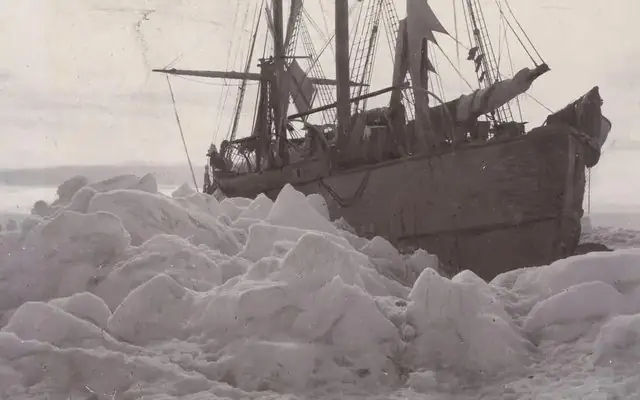
A deliberate journey into the pack
For many Arctic voyagers, becoming trapped in ice was the beginning of an emergency. For Fridtjof Nansen’s expedition, it was the intended starting point. The Norwegian ship Fram would enter the pack and travel with it, turning an obstacle to navigation into a means of transport. The plan depended on a vessel that could endure pressure and support people through prolonged isolation. During the expedition of 1893–1896, the ship became both shelter and scientific station. Its unusual achievement began with a practical question: could a wooden hull be shaped so that squeezing ice would push it upward rather than crush it?
The idea grew from evidence carried across the Arctic without a ship’s crew to guide it. The American vessel Jeannette had been crushed near the New Siberian Islands in 1881; debris identified as hers was later found in Greenland. The meteorologist Henrik Mohn interpreted the discovery as evidence of a current crossing the polar ocean. Nansen treated that possibility as something an expedition could test. Wreckage had survived a passage through an inaccessible region. A purpose-built ship might follow a related route with observers aboard, although the movement of the ice could not promise an exact track over the pole.
A hull and a home for pressure
Shipbuilder Colin Archer translated the proposal into timber and structure. In his firsthand account, Nansen explained that plans and models were repeatedly reconsidered. Fram became short and broad, with rounded, sloping sides and few projections for ice to grip. Internal supports reinforced the hull against external pressure. Wells allowed the propeller and rudder to be lifted onto the deck when necessary. These were interconnected precautions, not a claim that the ship was indestructible. The design favored a safe base in moving ice over speed and easy motion in open water, where its rounded form could produce an uncomfortable roll.
Keeping people warm mattered as much as keeping the hull intact. Cabins surrounded a central saloon, and layers of insulating material helped separate the occupied spaces from outside cold. Nansen described careful efforts to stop warm, damp interior air from producing ice against colder surfaces. The Polar Museum at UiT places the voyage within an approach that combined a relatively comfortable shipboard base, regular scientific work, and equipment informed by Indigenous knowledge. Conditions still demanded discipline. Shelter made a long investigation possible; it did not remove the need to maintain instruments, manage supplies, and continue observations through the polar night.
One expedition takes two routes
Fram left Norway in June 1893 and entered its long drift that September. The current did not behave like a conveyor belt aimed neatly at the North Pole. Changes of direction and slow progress forced the expedition to reconsider its options. In March 1895, Nansen and Hjalmar Johansen left with dogs, sledges, and kayaks to try to go farther north. Otto Sverdrup retained command of Fram and the remaining party. The expedition now had two related but separate stories: travelers crossing unstable ice, and a ship whose task was still to survive the drift and bring its observations home.
The sledging attempt also depended on knowing when to turn back. Nansen and Johansen reached a higher latitude than earlier recorded expeditions, but they did not reach the pole. Progress over broken ice was too difficult to justify continuing indefinitely. They headed south and eventually wintered in a small shelter in Franz Josef Land. Nansen’s later account makes clear how uncertain their geographical position could be, especially after their watches stopped. Their journey was not a simple outward march followed by a retracing of footprints. Ice, open water, food, and imperfect navigation continually altered what a return route could mean.
Returning with people and observations
In June 1896, Nansen encountered Frederick Jackson’s British expedition near Cape Flora. His published account begins the episode with the unexpected sound of dogs, followed by tracks and finally another person. Jackson’s party supplied help and a route home aboard Windward. Fram meanwhile continued under Sverdrup and escaped the ice near Svalbard that summer. The two groups returned separately to Norway in August. Preserving that distinction matters: Nansen’s dramatic meeting did not rescue a lost ship, and the ship’s safe arrival was the result of its own long continuation of the original plan.
The quieter outcome was a body of observations that could be studied after the celebrations ended. Oceanographic records included water temperature and salinity at different depths; density was calculated from the measurements. The National Snow and Ice Data Center’s modern dataset transcribes material published in the expedition’s scientific results, incorporating corrections rather than treating the nineteenth-century tables as infallible. A voyage intended to test an Arctic drift thus left evidence that could be reorganized for later researchers. Fram had not delivered its explorers to the pole. It had carried a working station through the ice and returned with information from an ocean few people had observed directly.