A population waiting to be counted
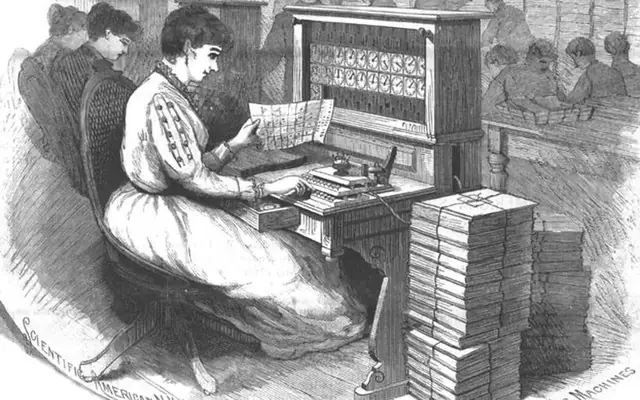
A cabinet covered in clocklike dials helped turn millions of people's answers into national statistics. Herman Hollerith's tabulator did not read handwriting or decide which questions a census should ask. Instead, information was transferred onto cards as holes in particular positions. Those holes could close electrical circuits, moving counters and helping operators organize the cards. Used for the United States census of 1890, the system joined an ordinary paper object to an electrical counting device. Its achievement was less a machine doing everything than a carefully arranged division of work between clerks, cards, readers, and sorting compartments.
The administrative problem had been growing for years. The Census Bureau's history records that final tabulations from the 1880 census were not completed until 1887. Earlier equipment devised by Charles W. Seaton had brought tally sheets together to make counting easier, but it could not keep pace with the volume of information. The next census promised still more work. Hollerith's opportunity therefore came from an organization struggling with its existing records, rather than from a market waiting for a general-purpose computer. Officials needed a faster route from handwritten returns to organized totals they could publish and use.
A test and an electrical reader
A competitive trial gave rival proposals a measurable test. In 1888 the Census Office compared methods using information from St. Louis. The agency's retrospective account reports that Hollerith's system took 72.5 hours to translate the sample information into machine-readable form and 5.5 hours to sort it. Both stages compared favorably with the other contestants. These figures describe the trial, not the time required to process an entire national census. Keeping the scale of the experiment clear matters: a promising demonstration still had to become an office routine involving many operators and a huge accumulation of cards.
The small holes supplied a physical link between a category and a counter. The Henry Ford's surviving 1890 machine illustrates the arrangement: a card was pressed beneath pins, and pins passing through holes could reach mercury-filled wells. A completed circuit registered information on the dials. Columbia University's computing-history account adds that the reader and sorter were electrically connected, while cards were still handled individually. At the end of a session, people recorded the totals and reset the counters. Electricity shortened part of the procedure, but the movement of paper and the preservation of results remained human responsibilities.
The work around the holes
Preparing the cards required another tool. A pantograph punch let an operator place a stylus over a marked template and make a corresponding hole in a card. The punched positions represented answers previously gathered on census schedules. A machine could then recognize the pattern without understanding a person's written explanation. Hollerith's patent, issued on 8 January 1889, described separate individual records and the counting of characteristics singly or in combination. The reusable card was central: information could be grouped and counted again for further analysis instead of being trapped in one handwritten tally or one completed pass through the apparatus.
The effect was substantial, but it was not an instantaneous census. The Census Bureau reports that the publication of the 1890 results was completed eighteen months sooner than publication of the 1880 results, despite the increased amount of information collected. The work produced thousands of pages, including twenty-five census volumes and many bulletins. This is a more useful measure than imagining every table appearing as soon as the population was counted. Enumerating households, transferring responses, checking and sorting records, preparing tables, and printing results were different stages. Improving one set of operations changed the whole schedule without abolishing the others.
A system larger than one machine
The equipment also opened a business beyond one government contract. Hollerith founded the Tabulating Machine Company in 1896; after later combinations, its corporate descendants became part of IBM's history. Government customers did not simply accept every subsequent arrangement, however. The Census Bureau's account describes dissatisfaction with rental prices and the development of replacement equipment under James Legrand Powers. That episode reveals another condition of technological adoption: an agency buying access to faster counting also had to consider the cost and control of its machinery. A successful invention could encourage both commercial expansion and the search for competing systems.
Hollerith's 1890 apparatus is best understood as an early data-processing system rather than a modern computer hidden inside wooden furniture. Columbia's account distinguishes its ability to count from the adding functions of later models and from subsequent automatic feeding. Its enduring contribution lay in making a standardized physical record available to a coordinated set of machines. The holes were simple; the organization around them was not. Behind the impressive bank of dials stood the quieter work of defining categories, preparing cards, moving them into groups, and deciding what the resulting numbers could reasonably say about a population.