A textile question becomes a book
Elizabeth Fulhame began with a question that belonged as much to textile decoration as to a laboratory: could cloth acquire gold or silver through a chemical process? Her attempt did not produce a simple recipe followed by a predictable triumph. It opened a long investigation into how metals changed, why moisture mattered and what light could do. In 1794 she published An Essay on Combustion, a book that made practical experiments the basis for disagreement with prominent chemical theories. The surviving record is unusually concentrated in that volume. Her uncertain biography should not be filled with an imagined laboratory, childhood or dramatic conversation.
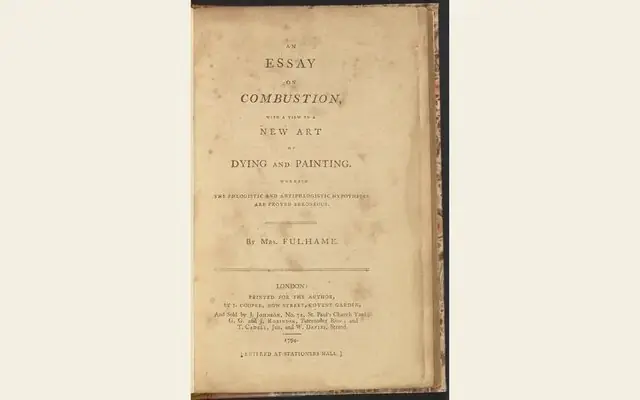
Fulhame's preface places the first idea in 1780. She described continuing the work over time, with the scale of her trials limited by money, and discovering that many more experiments were needed than she initially expected. The book appeared in London in 1794, printed for its author by J. Cooper. Wellcome's catalogue records its substantial length: preliminary pages followed by 182 numbered pages. Its title uses the contemporary spelling dying for what readers would now call dyeing. A project concerned with making attractive fabric had become a sustained printed argument about the processes responsible for chemical change.
Comparisons and the role of water
The experiments are more revealing than a retrospective label of genius. Fulhame compared the appearance of treated silk under different conditions, paying attention to dryness, moisture, exposure and time. Some trials ran for months. She recorded failures to obtain the expected alteration as well as successful deposits and changes of color. These contrasts gave her grounds to ask which part of a procedure actually mattered. A finished shining sample could attract admiration, but it could not by itself explain the result. The book's experimental sequences tried to connect visible effects with a reasoned account of how they had come about.
Water occupied a central place in that account. Fulhame rejected the idea that it merely spread dissolved substances into smaller particles. She proposed that it participated in reactions and could subsequently be regenerated. Historians associate this reasoning with the later concept of catalysis, and the Royal Society describes her essay as an early statement of its principles. That recognition needs careful language. She was not using today's complete chemical framework, and her broader claim that water was essential to all combustion does not become correct because one aspect of her argument looks forward to a later science.
Sunlight and competing explanations
Light supplied another demanding set of comparisons. In the essay's experiments on gold and silver, she described how treated fabrics altered when exposed to sunlight and how the presence or absence of moisture affected the outcome. Her observations belong to the history of photoreduction, chemical reduction brought about by light. They should not be turned into a claim that she invented a practical camera or made a photographic portrait. The Science History Institute preserves the book as a record of these investigations, while the Royal Society notes their later relevance to photographic pioneers. An experiment's eventual significance can extend beyond its maker's original purpose.
Fulhame was also writing amid a dispute about combustion. Supporters of phlogiston explained burning through a supposed principle released by combustible matter; their opponents developed explanations involving oxygen. She did not simply choose a famous camp and repeat its conclusions. Her title announced disagreement with both, and her closing arguments tried to make sense of oxidation and reduction through her own interpretation of the evidence. The important distinction is between recognizing her independence and endorsing every conclusion. Reading the work historically allows an experimentally resourceful investigator to hold some mistaken general ideas without erasing the value of her comparisons and observations.
Publishing an investigation in her own name
Publication presented its own uncertainties. Fulhame reported that a distinguished visitor who saw her samples in October 1793 offered to have a memoir presented to the Royal Society. She did not name him in that passage. The Society's modern account discusses Joseph Priestley as a candidate and considers possible reasons she published a book instead, rather than presenting those possibilities as settled facts. Her preface also confronted the hostility that learning could attract when its author was a woman. The finished volume was a means of putting her results before readers under her own name despite that anticipated judgment.
The book later reached another audience in an American edition of 1810, and institutional collections now preserve both the argument and the physical evidence of its publication. Its title page is more responsible as an illustration than an invented portrait of a woman whose life remains sparsely documented. Fulhame's history joins decorative ambition, patient trials and theoretical disagreement. The gold-bearing cloth was interesting in itself, but the larger contribution lay in treating unexpected results as questions worth pursuing. Her essay invites a reader to follow how an investigation develops, including its constraints and errors, instead of reducing discovery to one brilliant moment.