A pause between stop and go
Garrett Morgan's traffic signal offered an apparently simple improvement: before one stream of traffic began to move, everybody would stop. His United States patent, granted on November 20, 1923, described a mechanical device intended to make an intersection safer during the change from one permitted direction to another. That brief interval is the memorable part of the invention. The patent shows an inventor thinking about what impatient drivers might do in the seconds between two otherwise clear instructions, and designing a mechanism around that predictable behavior.
Morgan was born in Kentucky in 1877 and later built his career in Cleveland. According to the National Inventors Hall of Fame, he learned to operate and repair sewing machines while working in the clothing trade. He established businesses connected with sewing and hair-care products before his best-known safety inventions. This background helps connect activities that can look unrelated in a short biography. Mechanical repair taught him how equipment behaved in use, while running a business required him to persuade other people that an improvement was worth buying.
Reading the mechanism rather than the legend
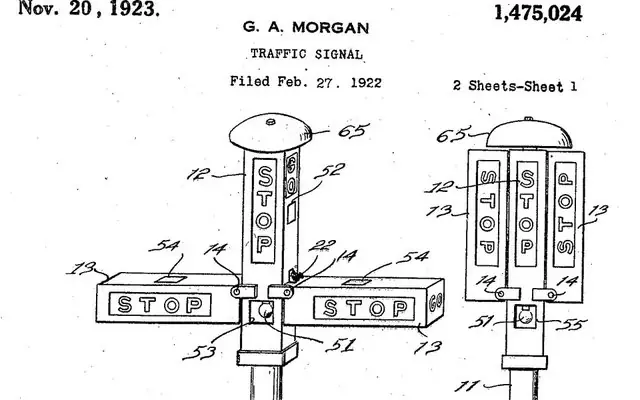
Traffic control was already an active field when Morgan applied for his patent in February 1922. His document acknowledges existing traffic signals and describes improvements, so it should not be read as a claim that he invented traffic regulation itself. The apparatus in its drawings used movable arms and a hand-operated mechanism. It was intended to give visible instructions at a crossing, including indications that could be understood from different approaches. This was a particular mechanical proposal in a crowded field, rather than the first appearance of a stop-and-go idea.
The specification explains why the intermediate position mattered. When opposing permissions changed immediately, drivers waiting to proceed could begin before vehicles already in the intersection had cleared. Morgan's arrangement could display a stop instruction in every direction before releasing the next flow. It also considered pedestrians, visibility, and convenient operation. Reading the actual document keeps the idea distinct from later electrical signals. The familiar account that Morgan invented the modern yellow light compresses a more specific story about a mechanical all-stop interval into a convenient symbol.
Another invention for dangerous spaces
He had previously addressed a different kind of dangerous transition: entering a space filled with smoke. His 1914 breathing-device patent, number 1,090,936, described a hood supplied through an air tube extending toward the floor. Its reasoning depended on seeking relatively cleaner air beneath rising smoke, with arrangements for managing airflow. The device was not a modern self-contained breathing apparatus. Understanding its historical design requires looking at the air source and the conditions it was meant to address, rather than treating every protective mask as the same technology.
In 1916, Morgan used a safety hood during rescue efforts after an explosion in a Cleveland waterworks tunnel beneath Lake Erie. The United States Patent and Trademark Office's history places the event within the hazards of expanding urban infrastructure. Morgan's actions demonstrated his willingness to use his own equipment in an emergency. Recognition nevertheless reflected racial prejudice: Black newspapers documented his role while prominent public accounts often overlooked him. The rescue made the relationship between invention, demonstration, and public credit unusually stark.
An inventor and his customers
Selling an invention could demand its own difficult strategy. The Patent and Trademark Office describes Morgan hiring a white salesman to promote the safety hood while he demonstrated it, countering customers who would reject a Black inventor's product. His hair-care advertisements addressed a different audience and could openly feature him. The technical object had not changed its inventor between these markets. What changed was the response he anticipated from prospective buyers, forcing him to adapt how the product and its maker were presented.
Morgan sold rights to his traffic-signal patent to General Electric for forty thousand dollars, according to the institutional histories. His complete mechanical system did not become the universal intersection standard, but its patent preserves a clear account of a safety problem and a proposed solution. He died in 1963 after a long entrepreneurial and civic life. The signal's appeal remains concrete: keeping people safe sometimes depends on inserting an orderly pause, and making that pause visible enough for strangers approaching from different directions to obey it.