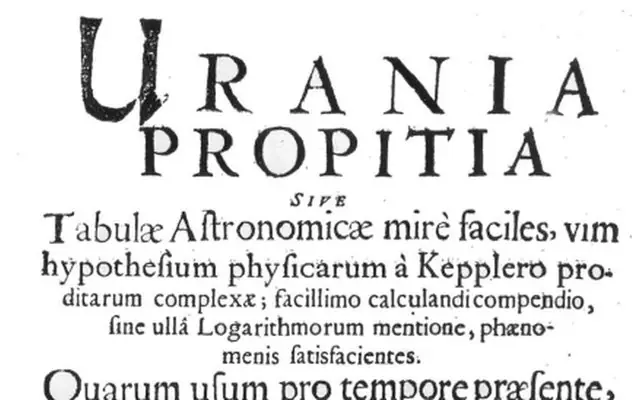
An ambitious promise on a title page
Maria Cunitz put an inviting promise on the title page of her 1650 astronomy book: its tables would make calculations easier without requiring logarithms. Urania propitia was a substantial technical work, not simply an introduction to looking at stars. Its author wanted people already interested in astronomy to obtain useful planetary positions with less labor. At a time when calculations had to be performed by hand, changing the route from a date to a prediction could be an important scientific contribution in its own right.
Cunitz lived in Silesia, in places now within Poland. Accounts disagree about her precise birth year, usually placing it between about 1604 and 1610. The Biographical Encyclopedia of Astronomers describes education received through her physician father rather than a university. Her second husband, physician Elias von Löwen, shared her astronomical interests. Their work took place amid the disruptions of the Thirty Years' War. This was scholarship carried through a household and correspondence, without the institutional path available to a male university student.
From planetary laws to practical arithmetic
The mathematical starting point was Johannes Kepler's Rudolphine Tables, published in 1627. Kepler's account of planetary motion offered powerful predictive methods, but applying them remained demanding. One problem was to find where a planet lay on its elliptical orbit at a particular time. Another was to translate positions related to the Sun into the positions an observer on Earth needed. Having an improved physical account of the heavens did not automatically make these calculations quick or convenient for the people using astronomical tables.
Cunitz reorganized the work into tables and arithmetic procedures. Historian Isobel Falconer describes approximately thirty thousand calculations behind the transformation, including entries based on time since a planet's aphelion, its farthest point from the Sun. Tables could do some of the labor in advance, leaving the user to combine entries and interpolate between them. The achievement was therefore partly a redistribution of effort. Years of preparation by the author could shorten the recurring calculations performed by later readers, without requiring them to reproduce her entire mathematical construction.
Writing for two readerships
The London Mathematical Society's account of its surviving copy describes roughly three hundred pages of numerical tables and another two hundred fifty pages of commentary. Explanations appeared in Latin and German, reaching beyond readers comfortable with the standard scholarly language. The title page itself announces this two-language presentation. German did not turn the book into effortless reading, since planetary astronomy still required skill. It did remove one barrier, allowing mathematical ability and Latin education to be less tightly bound together in the intended audience.
Authorship presented another obstacle. Löwen contributed a preface explicitly attributing the work to Cunitz and disclaiming that he had written it. Such a statement supported her claim while revealing that a woman publishing advanced astronomy might expect suspicion. Her university-hosted biographical entry also describes correspondence with astronomers including Johannes Hevelius, Pierre Gassendi, and Ismaël Boulliau. Scientific participation involved maintaining relationships as well as producing calculations. Letters provided a route into learned discussion even when the writer's career did not fit familiar institutional expectations.
A book within a scientific network
The book's practical reach is harder to measure than its surviving pages. It was privately printed, and Falconer notes that its print run and original price are unknown. That makes sweeping claims about widespread use unwise. One concrete reader was James Gregory, who bought it while equipping an observatory project at St Andrews in 1673. The purchase demonstrates that a later professional mathematician found a place for the volume among working astronomical resources. It does not by itself establish how every copy was used or how many readers owned one.
Cunitz died in 1664, leaving Urania propitia as her major published achievement. Its story is especially interesting because the apparently friendly promise of easier tables rested on sustained technical work. A reader could see columns of numbers and a bilingual explanation without seeing every calculation that made them possible. The surviving book restores that hidden effort to view. It also gives us a named woman author whose contribution to astronomy involved improving a practical tool, rather than discovering a new celestial object.