Lessons in the morning, spectacle later
The modern circus grew partly from a riding school. In 1768, Philip Astley and his wife Patty established an enterprise in London where equestrian instruction and public entertainment supported each other. Customers could learn to ride, while spectators paid to watch riders do things far beyond an ordinary lesson. Philip had served in the cavalry, but Patty was also an accomplished performer. Remembering both helps explain why the early circus was a working family business before it became an international entertainment tradition.
The Astleys began at Halfpenny Hatch in Lambeth. A newspaper advertisement dated April 4, 1768, preserved through Simon Fraser University's Reconstructing Early Circus project, promised nearly twenty different attitudes on one, two, and three horses. It offered evening performances through the summer except Sundays. Such notices place the enterprise within an existing market for horsemanship displays. Philip did not invent trick riding. His importance lies in the way he developed an enclosed venue and combined familiar skills into a program that paying audiences would return to see.
A ring with room for comedy
The circular riding area became a defining feature. The Victoria and Albert Museum credits Astley with recognizing the usefulness of a ring forty-two feet in diameter for equestrian balancing. A horse following a circle gives its rider a different problem from a horse moving straight ahead; repeated turns and a predictable path become part of the act. The dimension later associated with the standard circus ring therefore had a practical connection to the original attraction. It was a working performance space before it became a familiar symbol.
The entertainment soon included performers from fairs and pleasure gardens: acrobats, jugglers, rope dancers, clowns, and strongmen. Comedy could also come directly from riding. The V&A describes Philip's comic journey as a tailor traveling to Brentford, transforming apparent incompetence on horseback into an act. Patty's repertoire included a striking bee display while riding. These combinations made expert control entertaining in more than one way. Spectators might admire a difficult feat, laugh at a staged mishap, or marvel at a novelty in the same visit.
A business visible in advertisements
Advertisements expose the business beneath that variety. One from 1772 emphasized preparations to accommodate aristocratic visitors elegantly and asked them to arrive in time for the whole performance. Riding lessons were also advertised, with six lessons offered for a guinea. The people watching a show were potential pupils, while a pupil already knew the venue and its proprietor. This overlap helped an equestrian business reach different customers without depending on a single kind of transaction. Publicity, hospitality, and instruction belonged alongside the spectacular skills.
Prices also reveal a socially mixed audience with carefully differentiated places. The university project records a scale running from a gallery admission of sixpence to a box costing two shillings and sixpence. A surviving 1780 notice for the Amphitheatre Riding-House at Westminster Bridge advertised varied entertainments rather than a single feat repeated indefinitely. Its audience could pay for different experiences within the same building. The early circus brought people together, but seating and cost continued to distinguish their positions in the wider social world.
A show that traveled
The enterprise developed beyond an open riding ground. Roofing and theatrical stages expanded what could be presented and made performances less dependent on the weather. The French national library's circus history describes the amphitheatre Astley built in Paris in 1782, initially with an open-air ring, and its subsequent roofing and addition of a stage. Other entrepreneurs established related venues in Britain and North America. London also gained the rival Royal Circus in 1782. The entertainment formula spread through buildings, performers, competition, and journeys rather than through one fixed organization.
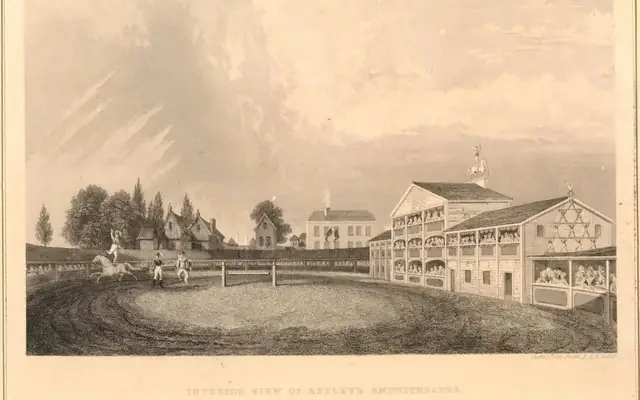
An engraving made in 1840 after William Capon's view of the amphitheatre as it appeared in 1777 offers a reminder that surviving circus images have histories of their own. It is a later representation of an earlier venue, not an eyewitness photograph of the first show. Read beside the advertisements, it helps recover a world of horses, spectators, showmanship, and constant revision. The Astleys' lasting achievement was to make that changing mixture into an attraction with a recognizable home in the ring.