A short paper reaches toward the whole Earth
In 1856, Eunice Newton Foote published a short paper that moved from two glass containers to a question about the whole Earth. Her experiments compared how air and other gases warmed in sunshine. Carbon dioxide, then called carbonic acid gas, produced a particularly strong result, and the container holding it took longer to cool. Foote suggested that an atmosphere containing more of that gas could make the planet warmer. The argument occupies only a small part of a brief article, but it links a material that could be handled in an experiment with conditions across geological time.
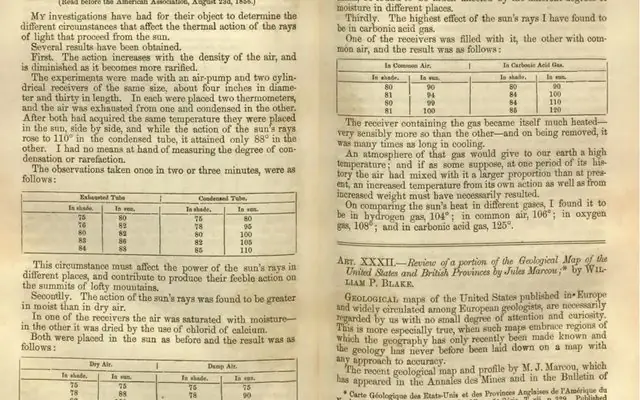
The equipment was straightforward, and her procedure was deliberately comparative. She used two cylindrical receivers of the same dimensions, approximately four inches across and thirty inches long. Each contained two thermometers. An air pump removed air from one receiver and compressed it in the other. After the temperatures had equalized, she placed the cylinders beside one another in the sun and recorded observations every two or three minutes. Her published tables include readings taken in shade as well as sunshine. The essential action was to change a condition while keeping an adjacent comparison available.
Reporting results and admitting a limitation
First she investigated density. The compressed air became hotter in sunshine than the rarefied air, a result she connected with the weaker heating experienced on mountains. She acknowledged a serious limitation: she lacked equipment to measure how much the air had been compressed or evacuated. Next came humidity. She saturated the air in one receiver with moisture and dried the other using calcium chloride. The damp sample warmed more. These are small but revealing details of a working researcher: Foote reported the preparation of her materials and admitted something her apparatus could not tell her.
The most consequential comparison placed carbon dioxide against ordinary air. Her table showed the cylinder containing carbon dioxide reaching the higher temperature, and her description emphasized its slower cooling. She then proposed that a greater proportion of this gas in an earlier atmosphere could help explain a hotter Earth. That was an inference beyond the immediate measurements, rather than a reconstruction of a particular ancient climate. It also concerned changes in atmospheric composition, rather than a forecast of industrial emissions. Reading her actual conclusion preserves its ambition without putting a modern climate model into her nineteenth-century laboratory.
Science within a life of reform
Foote's scientific interests belonged to a broader intellectual life. Born Eunice Newton in 1819, she grew up in New York and attended Troy Female Seminary, where women's education included science. She married Elisha Foote, an inventor and lawyer, in 1841. The couple lived in Seneca Falls and knew Elizabeth Cady Stanton. This setting connected domestic life, scientific curiosity, and organized reform. Her surviving experiments are therefore more intelligible when she is seen as an educated participant in public debates, rather than a solitary observer who somehow arrived outside the institutions and arguments of her time.
One record of that participation is the Declaration of Sentiments associated with the 1848 Seneca Falls convention. The National Park Service's transcription lists Eunice Newton Foote among the women who endorsed it and Elisha among the supporting men. The declaration challenged exclusion from voting, education, employment, and public authority. Those demands help explain the political world in which a woman carried out and circulated scientific work. They do not prove what she personally thought about every laboratory experience, but they establish her commitment to a collective claim that women should have a voice in shaping their society.
What the apparatus and the archive preserve
Her 1856 paper reached a major scientific meeting through Joseph Henry, the Smithsonian's secretary, who presented it in Albany. The reason he spoke for her remains uncertain. The experiment itself also requires care in interpretation: the jars did not isolate the absorption of infrared radiation responsible for the atmospheric greenhouse effect. Their heating involved an arrangement of glass, sunlight, and gas that could not separate every mechanism. John Tyndall's later apparatus investigated radiant heat more directly. Foote's contribution remains the early experimental comparison and climate inference, even when those different kinds of investigation are kept distinct.
Remembering her has its own history. An American Physical Society account points out that women historians discussed Foote before the well-publicized revival prompted by geologist Ray Sorenson in 2011. In particular, Elizabeth Wagner Reed recognized the climate significance of her results in a 1992 book about American women scientists. Foote herself published another paper, on electrical excitation, in 1857 and obtained patents before her death in 1888. Her career and its later recovery show two kinds of work: making observations that deserve attention, and finding the scattered records that allow later readers to understand what an earlier researcher actually did.