A letter made portable in print
A conversation with an absent friend became a way of bringing microscopic life before a wider audience. In 1857 Mary Ward had 250 copies of Sketches with the Microscope printed in Parsonstown, now Birr, Ireland. Its familiar address to Emily Filgate, a childhood friend, gave the account the intimacy of correspondence. The reader could imagine standing beside Ward's instrument while she selected objects to show. Print turned that imagined private demonstration into something portable: a person who could not visit her table could still follow the observations through words and pictures.
The instrument itself belonged to a serious practice of observation. The National Trust preserves an Andrew Ross brass microscope at Castle Ward, together with its mahogany case and accessories. Its collection record associates Ward with learning to prepare her own glass slides and using the instrument for her published work. A microscope did not simply produce finished scientific knowledge when someone looked through it. Selecting material, mounting a specimen, changing lenses, and making a faithful drawing connected the equipment to the page. Those practical skills were part of the authorship her readers encountered.
The craft and cost of publishing observations
The earliest printed book was also a carefully manufactured object. Examining the copy acquired by the Linda Hall Library in 2024, librarian Jason Dean identifies its blue cloth, stamped ivy decoration, and printer's imprint. Francis H. Shields, who owned the local King's County Chronicle newspaper, printed it. Advertising offered ordinary and deluxe bindings at three and four shillings respectively. Such details place Ward within the material business of publication. Scientific enthusiasm had to become paper, printing, illustrations, binding, and a price before it could move from an observer's desk into a reader's hands.
Her access to science had begun in a privileged household, although it did not follow a university curriculum. The Royal Irish Academy's Dictionary of Irish Biography describes education at home and parents who encouraged natural history and astronomy. Ward displayed specimens and illustrations to relatives, friends, and estate workers. The physicist David Brewster supplied material for examination, obtained books for her, and later used her illustrations in his own published work. These connections mattered because domestic study could reach a wider scientific network through correspondence, visiting specialists, and drawings considered accurate enough to reproduce.
Drawing across changes of scale
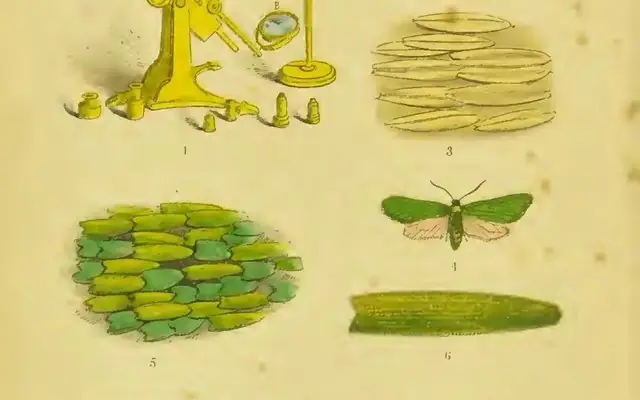
The later editions show how much information a small image could carry. The Linda Hall Library's discussion of its 1869 copy describes scales from weevils beside scales from perch and sole. A close view of markings on a perch scale resembles a fingerprint, making a difficult structure legible through an everyday comparison. Other illustrations move between an entire creature and a magnified detail. The shift in scale is central to the lesson: the familiar outline of an animal does not exhaust what can be observed, and an enlarged fragment needs a connection back to the body it belongs to.
Ward's 1857 illustrations offered another inventive change of viewpoint. In a plate devoted to insect eyes, she included a view of her room through a dragonfly's compound eye. The Linda Hall Library identifies fourteen hand-colored lithographic plates in that edition, drawn on stone by Ward herself. A study of feathers, a geranium petal, and moth-wing scales made ordinary materials into subjects of sustained attention. The room seen through an insect eye was particularly playful, bringing her immediate surroundings into the same investigation as the specimen. Scientific illustration could communicate a procedure while preserving curiosity and wit.
An invitation to take up the instrument
Writing also belonged to Ward's family economy. After her 1854 marriage, her husband's lack of regular employment helped create financial pressure as their household grew. Her work reached beyond one small printing: Groombridge and Sons issued A World of Wonders Revealed by the Microscope in 1858, followed by revisions and related publications. Her intended audience included amateurs, young readers, and women. The historical importance of that audience is easy to overlook if scientific achievement is measured only through formal membership or discovery claims. Explaining how to look could widen participation in observation even when professional institutions remained difficult for women to enter.
The 1859 second edition makes that invitation explicit in its preface. Ward acknowledges the powerful Ross microscope used for her research, then assures readers that many objects in the book can be examined with a less powerful instrument. The opening pages distinguish seasonal living specimens from prepared glass slides available throughout the year. This is practical advice about access, timing, and preparation, delivered through the voice of a friend. Ward's microscopic world consequently depended on more than enlargement: it required a writer who could turn what she saw into an activity that someone else might attempt.