A portrait fitted to its sitter
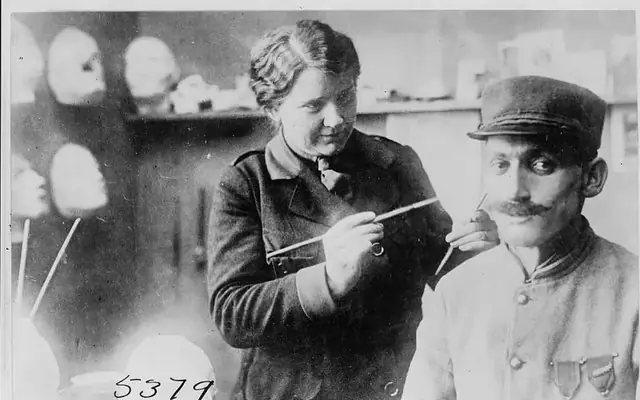
In a photograph from July 1918, Anna Coleman Ladd paints a mask while a French soldier wears it. The arrangement reverses the ordinary portrait studio. The likeness is not destined for a wall: it is being fitted to the person it represents. At the American Red Cross Studio for Portrait Masks in Paris, Ladd and her assistants used the skills of sculpture and painting to make thin coverings for severe facial injuries. Their work belonged to the aftermath of combat, when survival could bring lasting difficulties in public and private life.
The Library of Congress preserves that photograph within the American Red Cross collection. Its contemporary caption describes a copper reproduction, silvering, enamel, and the final application of flesh colors. Other photographs record casts and masks at different stages. These are particularly useful sources because they show a sequence of workshop operations rather than just an apparent transformation. A finished portrait mask could conceal much of its own manufacture; the studio records make the labor behind it visible and allow the surviving likenesses to be examined as crafted objects.
From sculptor’s studio to wartime workshop
Ladd was born in Philadelphia in 1878 and had established a career as a sculptor in Boston before the war. Her work included portrait sculpture and allegorical figures. Moving to Paris in 1917 brought that training into a new setting. She developed the portrait-mask studio under the American Red Cross, following an example established in Britain by sculptor Francis Derwent Wood. This was a shared response by artists and wartime organizations to a problem that neither an individual act of charity nor a conventional portrait commission could easily address.
The studio began with a cast of a soldier's face. Modeling then reconstructed the missing or damaged features, drawing on photographs taken before the injury when available. A thin metal version could be made from the resulting form. The task required both resemblance and fit: the mask had to meet the surviving face and suggest the person remembered in the earlier photograph. This was portraiture constrained by the requirements of something wearable, with the work judged at close range in changing circumstances rather than only on a studio pedestal.
The work behind a painted likeness
Color made the fitting still more exacting. The Smithsonian describes Ladd applying paint while the soldier wore the mask, so the surface could be matched to his complexion. Hair supplied details such as eyebrows and mustaches. Spectacles could help hold the finished piece in place. The process could take about a month for an individual mask. Those details explain why the studio's output depended on sustained attention from skilled hands. Producing a plausible face was an accumulation of small decisions about shape, edges, tone, and attachment.
The masks were cosmetic prostheses, with important limits. A painted metal surface could not move like living tissue or replace every function of an injured face. Its value must therefore be understood through the choices and circumstances of the people who wore it. It could provide a way to meet others with less unwanted attention, while leaving the underlying injury unchanged. The Library of Congress account emphasizes the social and psychological help the studio sought to offer. That purpose should not be mistaken for evidence that every recipient experienced the same result.
What a mask could and could not restore
Letters preserved among Ladd's papers add another kind of evidence to the photographs. The Smithsonian's transcription project includes correspondence concerning the Studio for Portrait Masks from 1919 to 1925. Together with casts, workshop images, and other archival material, such records help recover a relationship between artist and wearer. They also prevent the story from ending with one dramatic before-and-after comparison. A mask had to be used in a life beyond the photograph, and that life cannot be reconstructed from appearance alone. The wearer remained a person with preferences and relationships.
Ladd later received French recognition as a Chevalier of the Legion of Honour in 1932 and died in California in 1939. Her wartime work is remembered because it brought artistic training to an unusually intimate practical task. The best way to look at the studio photograph is to keep both participants in view: a sculptor concentrating on a painted surface and a soldier sitting through its adjustment. The object between them is at once a portrait, a prosthesis, and evidence of an effort to make everyday encounters more manageable after war.