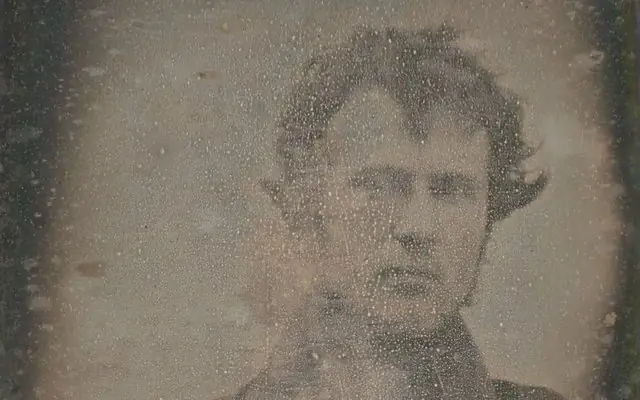
A camera in the family yard
Robert Cornelius looks surprisingly familiar in his photographic self-portrait: untidy hair, a turned-up collar, and a face directed toward the camera. The circumstances were less familiar. In October or November 1839, he made the picture outdoors behind his family's lamp and chandelier business in Philadelphia. His camera was an improvised box with a lens taken from an opera glass. The Library of Congress identifies the result as the earliest surviving American photographic portrait, a carefully qualified distinction that is more useful than an unrestricted claim about the world's first photograph.
The image is often called an early selfie. That modern shorthand catches the fact that photographer and subject were the same person, but hides the experimental difficulty. A person had to arrange light, apparatus, and pose without the immediate feedback of a screen. Long exposures made a human likeness especially challenging. The Library's catalog dates the plate to either October or November, rather than a securely known day. Even the small uncertainty is a reminder that a surviving picture does not automatically preserve a complete account of its making.
A picture made on silver
Cornelius was working soon after news of Louis Daguerre's process spread internationally. The Metropolitan Museum of Art dates the public explanation of its steps to August 19, 1839, in Paris. Earlier experiments by Daguerre and Nicéphore Niépce had already established that light could make lasting images. Cornelius therefore belongs to the early practical development of photography, rather than its invention from nothing. His achievement was to use the new process for a difficult subject and to become part of the effort to make photographic portraiture workable.
A daguerreotype is an object on metal. Its image forms on a polished silver surface carried by a copper plate. The result is a unique camera image rather than a negative from which a photographer can simply print a stack of matching pictures. It has a reflective surface whose appearance depends on the viewing conditions. A reproduction on a phone or a printed page conveys the likeness, but changes that physical encounter. Remembering the material helps explain why museums treat daguerreotypes as fragile objects requiring particular care.
From experiment to portrait business
Chemistry soon made portrait sitting more practical. Cornelius collaborated with Paul Beck Goddard, who modified the treatment of photographic plates by combining bromine with iodine. A Library of Congress account explains that this reduced exposures substantially. The importance went beyond convenience for one restless sitter. A portrait business needed customers who could remain still long enough to produce a satisfactory image, and it needed a process that could be repeated. Improvements in sensitivity helped turn an astonishing demonstration into a service people could purchase.
Cornelius opened a portrait studio in Philadelphia, yet his photographic career lasted only about three years before he returned to the family's lighting business. His short involvement warns against assuming that every pioneer followed the same professional path as later full-time photographers. Technical curiosity could move between workshops, trades, and commercial opportunities. A successful likeness was connected to experiments with lenses and plates, and the person making it might also be concerned with improvements to the quite different machinery and products of everyday urban life.
What the surviving object can tell us
The self-portrait entered the Library of Congress in 1996 through the Marian S. Carson collection. The catalog records an inscription on its paper backing claiming priority as a light picture. An inscription is evidence of how an object was described, rather than automatic proof of every claim it makes. Cataloging, comparison, and conservation help place that statement beside other evidence. The Library also restricts handling of the fragile original and provides digital surrogates, allowing the familiar face to circulate while limiting wear on the plate itself.
Looking again at Cornelius, the ordinary expression becomes part of the achievement. Photography could preserve a recognizable individual through a process that joined optics, chemistry, metalwork, and patient posing. The picture also raises questions that a catchy label can conceal: what survives, which geographical claim is being made, and how much is known about the exposure? Its significance remains strong when those questions stay open. A makeshift camera in a working yard helped show what a new medium might become, one difficult portrait at a time.