A London book by a Boston poet
When a reader opened Phillis Wheatley's Poems on Various Subjects, Religious and Moral in 1773, the poems were not the only remarkable thing inside. The volume also presented evidence intended to persuade readers that its author really had written them. Wheatley was a young African woman enslaved in Boston. Her literary achievement confronted assumptions so powerful that prominent men were asked to vouch for her authorship. The resulting book became an early landmark of African American literature, published across the Atlantic in London.
Wheatley was born in West Africa around 1753 and brought to Boston as an enslaved child in 1761. John and Susanna Wheatley purchased her. In their household she learned English and received instruction in subjects including classical literature. Access to books created opportunities for writing, but it did not remove her legal bondage. Keeping those facts together matters. Her education and literary development took place within slavery, rather than in a household relationship that can be adequately described as simple generosity or patronage.
The evidence printed before the poems
She began reaching readers before the book appeared. A poem published in the Newport Mercury in 1767 responded to an account of a dangerous sea voyage. Her elegy for the preacher George Whitefield, published in 1770, brought much wider attention. Religious verse, tributes, and occasional poems could circulate through newspapers and pamphlets as well as books. Wheatley's career therefore grew through the print networks of the eighteenth-century Atlantic. She had already established a public voice when plans for a collected volume took shape.
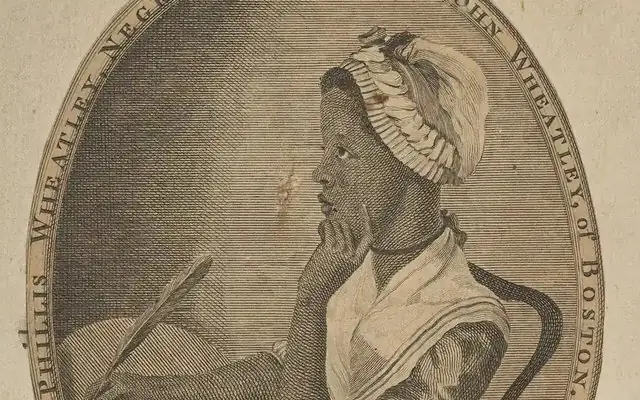
The book's prefatory attestation carries the names of Boston men who affirmed that Wheatley had composed the poems. Its presence reveals an unequal burden of proof: the writer's work was accompanied by assurances about the writer. Another part of the volume offered a different kind of introduction. A frontispiece shows her at a table with a quill, one hand raised to her face. The image presents a person engaged in thought. Its design is attributed to Scipio Moorhead, although that attribution is not securely documented by an engraved signature.
Freedom in the language of poetry
Unable to obtain publication in Boston, Wheatley traveled to London in 1773 with Nathaniel Wheatley, the family's son. Support associated with Selina Hastings, Countess of Huntingdon, helped the project. Archibald Bell published the collection that year. The Library of Congress preserves an original edition and records its London imprint. That physical volume is more than proof of a celebrated first. It preserves the arrangement of a book made for particular readers, through particular publishers and supporters, at a particular moment in the history of slavery and print.
Wheatley's poetry deserves attention beyond the endorsements surrounding it. In her address to the Earl of Dartmouth, she connected her longing for freedom with being taken from Africa and the grief of separation from her parents. Her literary language could place personal loss beside political hopes. Reading that poem complicates the idea that classical forms or religious references made her writing silent about enslavement. It also cautions against assuming that every poem has the same purpose. Elegy, dedication, prayer, and political address gave her different ways to speak.
An author beyond a famous first
Wheatley gained freedom after her return to Boston. She continued writing, including a poem sent to George Washington in 1775. His reply praised her work and invited her to visit his headquarters; the invitation itself is stronger evidence than later certainty about whether a meeting occurred. She married John Peters, a free Black man, in 1778. Literary recognition did not provide lasting financial security. Efforts to publish another collection met difficulties, and her later life included serious poverty. She died in Boston on December 5, 1784.
The 1773 portrait offers an appropriate way to return to her work. The quill and paper ask a viewer to recognize an author, while the inscription still identifies her through the man who enslaved her. Both belong to the historical object. Neither should make the poems disappear behind a biographical label. Wheatley's book survives as a record of practiced literary craft, a publishing venture spanning Boston and London, and a claim to intellectual authority made in a society determined to restrict who could possess it.