The bottleneck inside a shoe
A shoe can look simple until somebody tries to teach a machine to make it. Cutting leather and stitching pieces together were only part of the challenge facing nineteenth-century manufacturers. The upper also had to be pulled around a foot-shaped form called a last and secured in position. Jan Matzeliger recognized that this demanding operation was holding up the rest of production. His solution was a machine that could coordinate several skilled movements in a carefully arranged sequence.
Lasting gave a shoe its shape. Too little tension could leave loose material; pulling and securing the leather had to suit the form beneath it. A factory might turn out cut and stitched parts quickly while still depending on the pace of hand lasters to assemble them. The Lemelson program at MIT describes this mismatch as a production bottleneck. Matzeliger's opportunity lay in that imbalance: speeding one difficult stage could make the surrounding machinery more useful without inventing an entirely new product.
A workshop education across the Atlantic
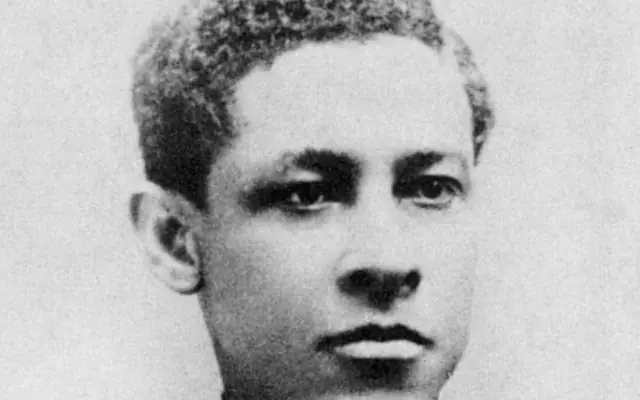
Born in Paramaribo in 1852, in the Dutch colony now called Suriname, Matzeliger had a Dutch father and a Surinamese mother. His early experience included work in machine shops supervised by his father. He later went to sea and settled in Philadelphia in 1873. By 1877 he had moved to Lynn, Massachusetts, a major center of shoemaking. His route into invention thus crossed both an ocean and several working environments before the lasting machine became his central project.
The National Inventors Hall of Fame describes an inventor studying hand lasters after his own factory work, consulting reference books, and acquiring secondhand drawing instruments. An early model used cigar-box wood, elastic, and wire. These materials make the story appealing, but they also identify the nature of the experiment. A small model could test how pieces moved together before money went into a sturdier machine. The problem demanded observation of an existing craft as well as the ability to build mechanisms.
An invention made of coordinated motions
The surviving patent supplies more precise evidence than a heroic invention anecdote. United States Patent 274,207 was granted on March 20, 1883, following an application filed on January 24, 1882. Its specification describes machinery for lasting boots and shoes, with drawings and numbered components. Matzeliger explicitly acknowledged earlier devices that performed parts of the operation. His claim was an improvement in mechanization and coordination, rather than the discovery that leather could be shaped over a last at all.
Among the combinations described are pinchers that grip and draw the upper, mechanisms that turn them to fold the material, and adjacent tacking devices. The document also discusses feeding and holding arrangements. This is a useful way to understand the invention: several ordinary-looking actions became a connected mechanical system. The patent heading names Matzeliger as assigning two-thirds of the rights to Melville S. Nichols and Charles H. Delnow. Even on the document celebrating an inventor, business ownership already formed part of the story.
The life behind the patent
Later versions substantially increased the number of shoes a lasting operation could handle. Accounts from MIT and the Inventors Hall of Fame report output far above that of a skilled hand laster, although their figures should not be read as the measured performance of every machine on every working day. The broader consequence is clearer than any single production total. Mechanizing a restrictive stage helped manufacturers produce footwear in greater quantities and contributed to making well-made shoes available to more buyers.
Matzeliger died of tuberculosis on August 24, 1889, shortly before his thirty-seventh birthday. He did not live through the long industrial career of the technology associated with his name. A United States Black Heritage postage stamp honored him in 1991. His lasting machine offers a particularly concrete reminder of how invention works: a familiar object contained a stubborn manufacturing problem, and a worker who understood machines spent years translating human dexterity into a repeatable arrangement of grips, guides, and fasteners.