A queen after the final moment
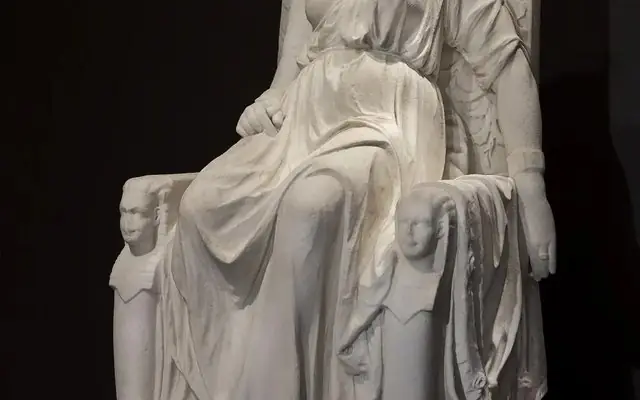
At Philadelphia's Centennial Exhibition in 1876, Edmonia Lewis offered visitors a queen whose life had already ended. The Death of Cleopatra places the Egyptian ruler on a throne, her head fallen aside and an arm hanging down. The work survives in the Smithsonian American Art Museum, but its journey there was anything but direct. A celebrated public display did not guarantee a permanent home, or even a secure place in public memory.
Lewis chose a familiar classical subject and made the moment unusually uncomfortable. Rather than showing Cleopatra considering her fate, she presented the aftermath of death. The Smithsonian records admiration alongside criticism of its realism. Drapery, a throne, and royal accessories establish dignity, while the slack pose refuses an entirely composed ending. These are choices by a nineteenth-century artist, rather than evidence that the sculpture shows exactly how the ancient queen died.
A career built through exclusion
Lewis's own early life is incompletely documented. The National Park Service places her birth near Greenbush, New York, at about 1844, and identifies her African American and Chippewa heritage. Supported financially by her brother, she entered Oberlin in 1859. The institution's reputation for reform offered no protection against racism. After she was accused of poisoning two students, a mob attacked her. Lawyer John Mercer Langston secured the dropping of charges for lack of evidence, yet continuing hostility and exclusion prevented her from completing her studies. An educational opportunity had become a threat to her safety.
In Boston she found a different network. Abolitionists offered commissions and practical encouragement, and portraits of figures associated with the antislavery movement established her professional standing. A bust of Robert Gould Shaw attracted particular praise. This support mattered, but Lewis wanted her work judged as art, rather than treated as a curiosity about its maker. She subsequently built a career in Rome, where American women artists offered companionship and guidance. Her studio drew prominent visitors, including Frederick Douglass. Recognition thus depended on both an artist's decisions and the people willing to sustain a working career.
The practical work behind the marble
A Smithsonian account of her Roman years explains what the city supplied: good marble and skilled craftspeople who could translate a sculptor's model into stone. Lewis rarely employed those carvers and completed much of the physical work herself, partly because her finances were limited. Her professional choices complicate an easy picture of sculpture as a solitary burst of inspiration. A finished marble required money, materials, space, labor, and transport. For an artist building a reputation across the Atlantic, those practical requirements were part of the work's history before any spectator encountered its subject.
Cleopatra also belonged to a much wider body of work. The Massachusetts Women's History Center describes Lewis's portraits, religious figures, literary subjects, and sculptures addressing emancipation and Indigenous heritage. Works such as Forever Free, Hagar, and Old Arrow Maker show why a single famous object cannot stand for the whole career. Their subjects brought different histories into a medium associated with classical authority. Looking across them makes Cleopatra less an isolated marvel and more one ambitious choice by an artist who repeatedly decided whose experience could become the subject of monumental, carefully worked stone.
A sculpture outside the museum
The sculpture's later history is a warning about how uncertain an artwork's survival can be. In a Smithsonian oral-history interview, historian Marilyn Richardson traces a journey through a saloon, a horse's memorial, a junkyard, and finally a shopping mall's storeroom. She identified the signed marble there in 1988, surrounded by seasonal decorations. These settings had given it purposes far removed from its exhibition debut, yet the object remained available to be recognized. In 1994 it entered SAAM through a gift from the Historical Society of Forest Park, Illinois, as the museum's collection record confirms.
Lewis died in London on September 17, 1907. The Women's History Center notes that many of her works remain unaccounted for; her present reputation rests on a surviving portion of a larger output. That makes the recovery of Cleopatra significant beyond the pleasure of a rediscovery story. A preserved object permits new questions about technique, ambition, ownership, and neglect. It also prevents a museum label from becoming the whole account: the sculpture had an earlier audience and a long life outside museums. Its survival allows viewers to recover something of the working artist as well as the queen she carved.