A small star restores a name
A star can be an artist's signature as well as a celestial object. For Judith Leyster, the small symbol attached to her initials eventually helped recover a career that later collectors had largely lost from view. In 1893 the art historian Cornelis Hofstede de Groot identified her monogram on seven paintings and published a study of her work. Pictures that had circulated without her name could now be considered together. The discovery did not create a talented painter; it began restoring authorship to one who had already enjoyed recognition in seventeenth-century Haarlem.
Leyster entered Haarlem's Guild of Saint Luke in 1633. Guild membership gave her the standing to operate a studio, sell work, and train pupils. Painting was an occupation through which she earned money, rather than simply an accomplishment practiced in private. Her pictures often concentrate on contemporary people, their activities, and their expressions, leaving backgrounds comparatively spare. Loose strokes make a face or gesture seem immediate, but that apparent ease required control. Her resemblance to Frans Hals in handling paint does not establish that she trained with him: the documentary evidence does not settle that question.
Presenting a working painter
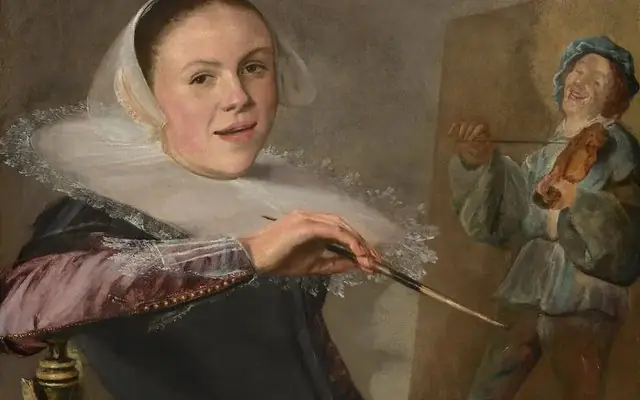
Her self-portrait of about 1630 makes the professional claim visible. Leyster turns from an easel toward the viewer, with a brush poised in her hand. A violin player occupies the canvas behind her, while her other hand gathers a palette and numerous brushes. The picture presents someone equipped to work and confident enough to meet a potential customer's gaze. The National Gallery of Art dates the painting approximately, so it should not be treated as a photograph of a precisely identified day. Its carefully arranged encounter is itself part of the artist's achievement.
The portrait also rewards technical investigation. Arthur Wheelock's National Gallery study explains that infrared examination revealed an earlier woman's face beneath the violin player on the easel. Leyster changed the image within her image, making the finished composition a record of decisions rather than an untouched first idea. The same study questions the proposal that the portrait was her guild admission piece in 1633, favoring a date around 1630 on stylistic and costume grounds. Its elegant clothing likewise belongs to a deliberate presentation of artistic status, rather than reliable evidence of everyday studio dress.
Music, mischief, and interpretation
Music offered another setting for her study of people. In The Concert, dated about 1633 by the National Museum of Women in the Arts, a singer and two instrumentalists share a compact space. A songbook and the handling of the instruments give the scene practical detail. Suggestions that the singer represents Leyster and the violinist her future husband remain tentative identifications. The musicians' coordinated activity has also encouraged an interpretation in terms of harmony. Such readings can enrich the picture while remaining distinct from securely documented facts about who the sitters actually were.
A different sort of interaction appears in A Boy and a Girl with a Cat and an Eel, made about 1635 and now in London's National Gallery. The boy holds an eel beyond the cat's reach while restraining the animal; the girl appears ready to pull its tail. Their amusement has an uncomfortable edge. The gallery connects the scene, cautiously, with a Dutch warning that provoking cats invites scratches. The children's clean, fashionable clothing complicates any easy assumption that disorder belonged only to the poor. Leyster made expression and misbehavior subjects for close observation.
A career recovered through evidence
She married the painter Jan Miense Molenaer in 1636, after the period in which most of her surviving paintings were produced. The National Museum of Women in the Arts notes that her output then diminished; managing property, family affairs, and aspects of the household's artistic business may have occupied her time. Those possibilities should not be turned into a complete reconstruction of an undocumented working day. After her death in 1660, some works became confused with those of Hals. A famous name on a label could conceal the difference between the two painters' artistic careers.
Recovering Leyster consequently required more than admiring lively brushwork. Monograms, archives, comparisons, and examination of paint each supplied different kinds of evidence. Her star-shaped signature played on the meaning of her surname, associated with a guiding star, but the unsigned self-portrait needed other arguments before it could securely return to her. That distinction matters: a compelling rediscovery story should not imply that every picture yielded the same clue. Looking across these works restores a varied professional practice, from self-presentation to music and moral comedy, and allows the painter's own choices to become visible again.