Soft and loud at the keyboard
The name piano hides an instruction about volume. In Italian, piano means soft; forte means loud. Bartolomeo Cristofori's new keyboard instrument could produce both through the player's touch. That sounds unsurprising to anyone who has pressed a modern piano key, but it required a sophisticated mechanical departure from the harpsichord. Cristofori did not merely put a different label on a familiar box. He worked out how a finger could launch a hammer at a string and then let that string vibrate freely.
Born in Padua in 1655, Cristofori entered the service of Ferdinando de' Medici in Florence in 1688. Maintaining a princely collection of instruments placed him among the materials, tools, and musical demands that encouraged experimentation. A Medici inventory from 1700 records a keyboard of his new invention capable of soft and loud playing. The instrument therefore existed well before the surviving example dated 1720. That distinction matters: the oldest piano available for inspection is evidence of an established workshop practice, not necessarily the first attempt.
The hammer must leave the string
A harpsichord normally sounds its strings by plucking them with small plectra. Pressing a key harder does not provide the same direct control of loudness that a piano offers. Cristofori substituted a striking mechanism, but striking introduced a difficulty. If the hammer remained against the string while the player held the key down, it would suppress the vibration it had just started. His escapement let the hammer continue toward the string and fall away, even though the finger still depressed the key.
Other parts had to cooperate with that escape. A check restrained the returning hammer so that it did not bounce into an unwanted second blow. Dampers stopped strings after notes were released. The case and stringing also needed attention; a usable piano was a whole instrument, rather than an isolated clever lever. Thinking through one note reveals the achievement. A brief movement of a finger had to control attack, release, silence, and readiness for another note through a sequence that the player could feel but did not have to manage consciously.
An invention travels on paper
In 1711 the writer Scipione Maffei published a description of Cristofori's invention with a diagram of its action. This gave makers beyond Florence a way to examine the design without owning an example. Translation helped the information circulate farther. The instrument was slow to gain an audience in Italy, and later builders did not simply preserve every feature of Cristofori's complicated mechanism. Some economical designs omitted solutions that would become valuable again. The piano's development consequently involved adaptation and rediscovery as well as the spread of a successful idea.
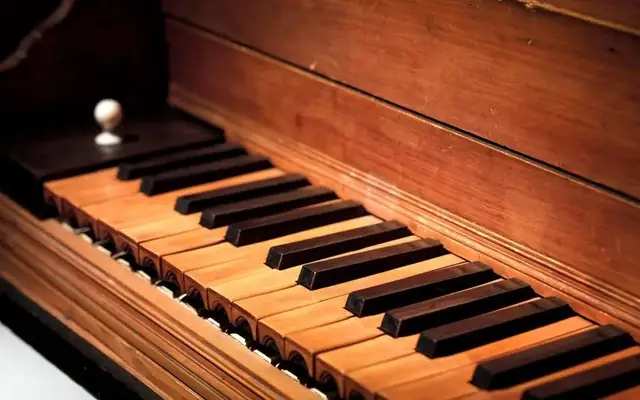
The Metropolitan Museum of Art's 1720 piano supplies a more tangible record. Its materials include cypress, boxwood, leather, and fir, and its long, tapered case still suggests a harpsichord. It has fifty-four keys, fewer than the eighty-eight familiar on many modern instruments, and no foot pedals. These differences make it misleading to imagine the sound of a present-day concert grand coming from this smaller keyboard. The museum identifies it as the oldest of three surviving pianos by Cristofori, whose later instruments belong to the 1720s as well. Its present condition also reflects later alterations and restorations, as conservator Stewart Pollens emphasizes.
A surviving instrument with its own voice
The Met's curatorial discussion connects the invention with an age fascinated by the expressive possibilities of voices and violins. A singer could shape a phrase through changes of intensity; the new keyboard offered another way to explore that musical language. Its eventual importance should not erase the musicians who learned what to do with it. A mechanism makes certain effects possible, but players and composers turn those possibilities into habits, styles, and expectations. The soft note was a technical event before it became an ordinary musical choice.
The illustration is the museum's freely released photograph of the 1720 instrument, cropped to the site's landscape format. It depicts a surviving object rather than an imagined scene of invention. Looking at its keyboard makes the familiar keyboard seem less inevitable: beneath an orderly row of keys lay a problem of timing and motion. Cristofori's essential trick was to make a hammer strike with authority and then withdraw. The instrument acquired its voice because a tiny machine knew precisely when to stop touching the string.