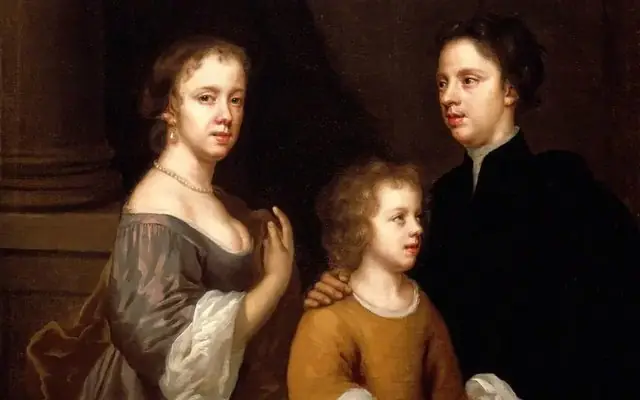
A household organized around painting
A family portrait by Mary Beale shows the painter beside her husband Charles and their young son Bartholomew. The grouping looks domestic, but it also introduces a household that would organize itself around her professional work. Beale, born in Suffolk in 1633, became one of the English women who earned a living through portrait painting in the seventeenth century. Her career was sustained by skill, personal connections, and a practical division of labor. The unusual survival of her husband's notebooks allows us to look past the finished portraits and examine how pictures became the family's income.
An artistic career was difficult to build when women had limited access to training and professional networks. Beale began by painting friends and relatives, using gifts as a way to make her ability known among people who might recommend her. Historic England emphasizes this careful management of reputation, as well as her public identity as a respectable family woman. Such social expectations shaped the conditions in which her paintings circulated. A successful likeness had to reach potential clients, and its maker needed sufficient trust and recognition to turn a private accomplishment into a repeatable professional service.
Inside the working studio
Following a period in Hampshire during the 1660s, the family returned to London, where Beale established a professional studio around 1670. Charles handled its administration and assisted with the technical work, while their sons helped with backgrounds. She also wrote about friendship and the importance of equality between husband and wife, an argument with a particular resonance in this household. Their arrangement gave her work the central economic role rather than treating it as a minor supplement. The studio was a family enterprise, but the portraits and the reputation that attracted its customers were hers.
Charles's surviving notebook for 1680–1681 records commissions, payments, purchases, and working methods. An entry for April 1681 notes ten pounds received for a half-length portrait of Lord Downe. Other entries concern brushes and the thin application of white poppy oil to a picture painted on an onion bag. The same volume includes domestic expenditures, placing household needs beside the costs of producing art. These details make the book useful beyond biography. They show that portrait painting required materials, scheduling, accounts, and technical decisions, all of which had to be managed before a finished canvas could leave the room.
Commissions, teaching, and experiments
Beale's professional circle included Peter Lely, the fashionable court painter whose work she studied and copied. The National Museum of Women in the Arts records a peak of eighty-three commissions in 1677, evidence of considerable demand rather than an occasional sideline. Her customers ranged from acquaintances to members of the gentry, nobility, and clergy. Teaching also formed part of her activity: among her pupils were women, including Keaty Trioche and Sarah Curtis. The workshop consequently offered another route into artistic practice at a time when the usual institutional doors were often difficult for women to enter.
The family also treated painting as a field of experiment. Charles prepared paints and supports, bought supplies, and recorded the results of using less expensive materials. Beale worked on sacking, bed-ticking, and onion bags as well as more conventional supports. Such choices bring the history of art close to the history of household fabric and workshop economy. Success was not permanent: as the taste for Lely's courtly style declined, demand for Beale's portraits weakened, and her recorded commissions averaged thirty-nine a year in the 1680s. A long career involved adapting to a changing market, not simply enjoying an uninterrupted rise.
Portraits and accounts as evidence
Her self-portrait of about 1666, now in the National Portrait Gallery, offers a different kind of evidence. Beale holds an unfinished canvas showing the heads of her two sons, while an artist's palette hangs nearby. Her elegant clothing resembles the fashionable presentation familiar from contemporary portraiture rather than a painter's working outfit. The picture brings professional identity, motherhood, and social standing into the same composition. It does not give a candid view of an ordinary afternoon in the studio. It shows how deliberately a woman artist could present the several roles through which viewers understood her work and her place in society.
Beale continued painting into the 1690s and died in 1699. Her reputation later suffered when works were attributed to male painters, including Lely and her own son. Recovering the correct names changes more than a label: it restores the scale of a professional achievement that was easier to overlook when the pictures were scattered under other identities. The portraits and accounts together make an especially revealing record. One preserves the appearance that clients wished to purchase; the other preserves the work and organization behind it. Reading them alongside one another returns Mary Beale to the center of the business she sustained.