A weather forecast with living parts
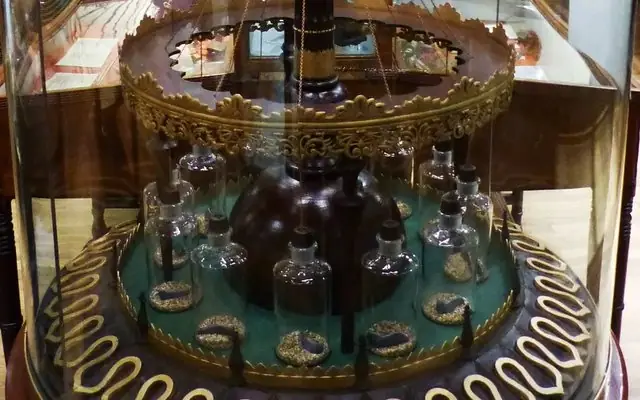
Visitors to London's Great Exhibition of 1851 could encounter an instrument that tried to make weather forecasts with live leeches. George Merryweather, a physician and museum curator in the Yorkshire port of Whitby, called it the Tempest Prognosticator. Twelve glass bottles surrounded a stand beneath a bell. Each bottle housed a leech, whose upward movement could trigger a signal. The apparatus gave animal behavior a remarkably elaborate public stage. Its decorative appearance was only part of the attraction: Merryweather believed it offered a practical way to anticipate dangerous storms.
Whitby supplied a compelling setting for that ambition. Ships, harbor activity, and the exposed coast made changes in weather consequential matters. In his published explanation, Merryweather described opportunities to observe the sea from the piers and cliffs. He wanted advance warning to protect lives and property. His medical work also made leeches familiar animals, rather than unlikely objects to find in a doctor's possession. Moving them into a meteorological device linked an established part of nineteenth-century treatment to the larger hope that nature might provide readable warnings before disaster struck.
What a ringing bell could establish
The signaling mechanism was specific and mechanical. A small piece of whalebone rested in the narrow passage associated with each bottle and was connected by wire and chain to a hammer. A leech climbing into the passage could dislodge the piece, causing the hammer to strike the bell. More activity among the bottles produced more signals. This arrangement translated movement that might otherwise go unnoticed into a sound an observer could hear. The animal supplied the motion; the apparatus made that motion communicable beyond the glass container.
Merryweather explained the proposed cause in terms of atmospheric electricity and the animals' sensitivity to it. Those explanations belong to his historical theory, not to an established demonstration that the instrument predicted storms reliably. A device can be mechanically successful at ringing when an animal moves while failing to identify the weather that will follow. Distinguishing those questions helps explain the prognosticator without either dismissing its craftsmanship or accepting its inventor's claims. The first question concerns a trigger and a bell. The second requires a dependable relationship between behavior, timing, and subsequent conditions.
Predictions recorded before the event
He did try to establish a record before announcing his results. During 1850, he sent dated predictions to Henry Belcher, president of the Whitby Philosophical Society. His 1851 essay printed a series of these notices and responses, inviting readers to compare his warnings with later storms. One January letter predicted bad weather within forty-eight hours despite a bright, calm morning. Postal timing helped demonstrate that a forecast preceded the event it claimed to anticipate. This was a serious evidential concern: remembering a successful prediction after a storm is much easier than preserving a prediction before it happens.
Yet the printed correspondence was not the same as a controlled evaluation. Some notices allowed broad windows of time, and Merryweather sometimes discussed disturbances at distant places as well as local weather. To assess reliability, an investigator would also need consistent rules about what counted as a storm, where it must occur, and how to count warnings that were not followed by one. Those requirements are an inference from the testing problem, rather than a result Merryweather established. His confidence exceeded what a selection of reported successes alone could demonstrate about a forecasting system.
The exhibition object and its later replicas
The exhibition model dressed this idea in an elaborate architectural form. Merryweather proposed versions for different budgets and expected wide use, including service to mariners. That future did not arrive. The original exhibition device was lost, and the object now displayed at Whitby Museum is a replica made for the Festival of Britain in 1951. The museum notes that its bell is cardboard, so it is not a working example. A separately constructed working model later entered the National Meteorological Library and Archive. These later objects preserve the design's interest without proving its forecasting claims.
The accompanying photograph shows the Whitby replica in its display case. Its bottles and ornament make a memorable image of Victorian invention, but the more revealing survival may be the essay with its dated letters. Merryweather understood that a prediction needed a record. He also showed how difficult it was to move from an intriguing observation to a dependable public instrument. The leeches offered a signal, and the bell made it audible. Whether that signal provided useful knowledge of tomorrow's weather remained a further question that the spectacle itself could not answer.