A chessboard as a stage
An eighteenth-century audience could watch a seated figure move chess pieces, then wonder whether a machine had learned to think. The Mechanical Turk, built by Wolfgang von Kempelen for the Habsburg court, made that question into a profitable spectacle. Its figure wore a turban and sat behind a cabinet topped by a chessboard. Before a game, the exhibitor opened doors to display machinery. During play, the arm reached out to make apparently deliberate moves. The intelligence was real, but it belonged to a skilled human concealed within the apparatus.
The presentation drew strength from a period fascinated by mechanical imitations of life. Clockwork musicians and writing figures demonstrated extraordinary craftsmanship. Chess seemed to promise something beyond repeating a rehearsed sequence: a player had to respond to an opponent's choices. Kempelen's cabinet therefore invited a different kind of wonder. The costume also borrowed the period's European taste for supposedly exotic Turkish imagery. It was part of the theatrical packaging, rather than an explanation of the machine's origins or evidence that an Ottoman engineer had created the device.
What the open doors did not establish
A spectator saw selected views of the interior, not an unrestricted inspection of the whole cabinet at once. This distinction became central to Robert Willis's analysis published in 1821. Willis observed that the exhibitor followed a regular order when opening compartments. He proposed movable partitions and concealed spaces that would let an ordinary-sized person change position as different doors opened. The apparent abundance of visible gears helped distract attention from the available room. A cabinet could seem completely occupied by machinery while still offering a carefully managed refuge for its operator.
Willis also questioned the evidential value of winding a key. The sound and gesture suggested clockwork power, but spectators could not see that power driving the arm. He noted that winding did not bear a consistent relationship to the number of moves played. His larger reasoning had a limitation: he treated flexible chess intelligence as beyond machinery, a claim later computers would overturn. His useful contribution was more particular. He separated what an audience actually witnessed from the explanation it was encouraged to accept and proposed a physical arrangement that could account for the performance.
Mechanisms serving a hidden player
A hidden player needed information as well as space. In the reconstruction made by the Heinz Nixdorf MuseumsForum, magnets in the pieces communicate their positions to indicators underneath the board. A pantograph, a linked arrangement of levers, transfers the operator's movements to the visible arm. The museum emphasizes that no complete construction plans survived, so its functioning replica required experimentation. It illustrates how the illusion can work without making every reconstructed detail an independently verified feature of Kempelen's original. Mechanical ingenuity served human decision-making rather than replacing it.
After Kempelen's death in 1804, Johann Nepomuk Mälzel acquired the apparatus and extended its touring life. European audiences were followed by paying spectators in the United States and Cuba. The show generated explanations as well as ticket sales. Edgar Allan Poe saw it in Richmond and published his own analysis in 1836, arguing for a concealed human operator. Such publications show that suspicion accompanied the spectacle. The cabinet did not have to convince every observer forever; uncertainty and argument could themselves sustain interest in seeing it perform.
A lost object and an enduring puzzle
The original was destroyed in a Philadelphia museum fire in 1854. Its loss matters because modern historians cannot simply open the surviving cabinet and settle every question about its successive arrangements. Prints, descriptions, analytical pamphlets, and records of exhibition must do that work together. The museum replica first demonstrated at Paderborn in 2004 belongs to this later history of investigation. It turns an old deception into an openly explained engineering exercise. Audiences can admire the dexterity required while knowing that the chess judgments come from a person inside.
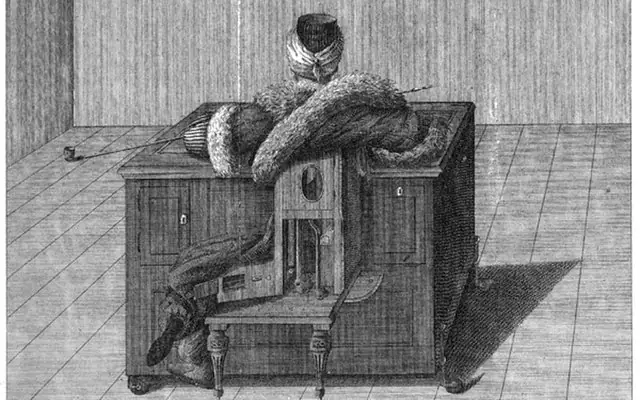
The accompanying historical engraving depicts the figure and cabinet with compartments opened. It preserves the very invitation that made the act persuasive: look at all this machinery and decide what must be moving the hand. The better question is what remains outside the permitted view. Seen that way, the Turk is an unusually vivid lesson in evidence. Its achievements involved mechanisms, concealment, and performance, while its reputation rested on attributing the result to the wrong source. The invisible worker was not incidental to the machine's success; that worker supplied its game.