A name after a verdict
In August 1781, an enslaved woman known as Bett and an enslaved man named Brom challenged John Ashley in a Massachusetts courtroom. Their case asked whether he could legally hold them for life after the state had adopted a constitution grounded in natural rights. The surviving records are a small group of pleadings, writs, and court entries, but their consequence was enormous for the two plaintiffs. Both won their freedom. Bett subsequently chose the name Elizabeth Freeman, turning a legal victory into a public statement about who she now understood herself to be.
Ashley was a powerful landowner in Sheffield, in the Berkshire region of western Massachusetts. His household and businesses depended on people he enslaved. The Trustees of Reservations identifies at least eight people held in bondage there, including Bett, her daughter Betsey, and Brom. Meanwhile, Ashley participated in the political campaign against British authority. In 1773 he chaired the committee behind the Sheffield Resolves, which asserted natural equality and independence. Those principles could circulate upstairs in a prosperous house while slavery organized the work that sustained it. Freeman's challenge exposed the distance between the political language and the household's practice.
A remembered beginning and a surviving procedure
The familiar account of her inspiration needs careful handling. Later writers described her hearing a declaration of equality and asking a lawyer to make that promise apply to her. Catharine Maria Sedgwick, who knew Freeman through her family, preserved a version of her life in an account published in 1853. It is valuable testimony, but it was written long after the lawsuit. Freeman left no written autobiography, and modern accounts differ about which revolutionary document she heard. Her determination is evident in the action she took; the precise conversation that prompted it remains uncertain.
Theodore Sedgwick and Tapping Reeve assisted the plaintiffs. The initial procedure was striking: a writ of replevin, a legal mechanism for recovering property said to be wrongfully held. In this case, that familiar form became a means of contesting the claim that two human beings belonged to Ashley at all. The order required him to release Brom and Bett, but he refused, and the dispute proceeded to trial. Revolutionary language did not simply enforce itself. The plaintiffs needed access to legal representation, a court willing to hear the dispute, and a process capable of challenging an established owner's authority.
What the court record establishes
The case came before the Berkshire County Court of Common Pleas in Great Barrington that August. The Museum of the American Revolution stresses an important limitation: there is no surviving transcript of the trial, only the verdict. We cannot reconstruct the courtroom speeches word for word. What survives establishes that the jury rejected Ashley's claim to hold Brom and Bett for life. The court awarded damages and costs as well as recognizing their freedom. Ashley initially sought an appeal but abandoned it. The documentary result is firmer ground than any imagined scene of dramatic exchanges before the jury.
This judgment was one part of a wider legal transformation. It did not, by itself, enact an abolition statute or instantly release every enslaved person in Massachusetts. Separate proceedings involving Quock Walker culminated in 1783 with Chief Justice William Cushing treating slavery as incompatible with the state constitution. Together, such cases made claims of lifelong ownership increasingly impossible to defend in court. The distinction matters: legal institutions changed through several challenges brought by enslaved people, rather than through a single uncomplicated announcement. Freeman and Brom belong within that larger process without losing their own particular achievement.
Life beyond the lawsuit
Freedom also had an everyday history after the verdict. Freeman worked for wages in the Sedgwick household for more than two decades and became known for her skills as a midwife and healer. Saving money allowed her eventually to acquire a home and land in Stockbridge. Her estate included nineteen acres as well as furniture, clothing, and jewelry. These possessions record choices and economic work that a courtroom victory alone could not supply. Rather than ending her story at emancipation, they let us see a woman building material security and making arrangements for the people who would survive her.
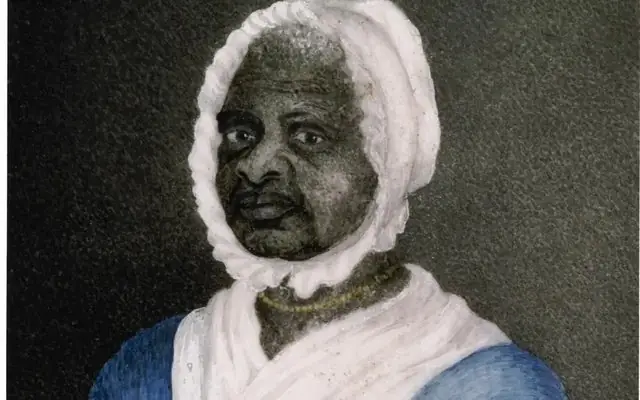
The accompanying image shows a detail of Susan Anne Livingston Ridley Sedgwick's miniature portrait, catalogued by the Massachusetts Historical Society to 1811. Freeman wears a white bonnet, a blue dress, and gold beads at her neck. It depicts her decades after the lawsuit, rather than illustrating the trial itself. The small watercolor on ivory preserves an individual face where legal records preserve a dispute over status. Together, portrait and paperwork offer complementary evidence: one records the successful challenge to ownership, while the other makes room for the person whose life continued beyond it.