An ordinary container with a difficult bottom
A paper bag that opens into a boxlike shape seems almost too ordinary to have an inventor's story. Yet making its bottom repeatedly, quickly, and neatly presented a demanding manufacturing problem. Margaret Knight tackled that problem while working in the paper-bag industry in Massachusetts. Her machine coordinated feeding, cutting, folding, and pasting so that a practical container could emerge from moving paper. The achievement concerned a method of production: paper bags already existed, including flat-bottomed examples made by hand. Knight made a complicated sequence of hand movements into machinery that could repeat it.
Born in Maine in 1838, Knight developed practical skills through work rather than a formal engineering education. She made toys as a child and later worked in several trades. Accounts of her youth describe a dangerous incident involving a flying loom shuttle and a safety device she devised in response. That early story is often retold, but her mature paper-bag invention offers much firmer documentary ground. Patent specifications and surviving models let us examine an actual mechanism, rather than relying entirely on later recollections about a mechanically gifted childhood.
Turning folds into a working sequence
By 1867, Knight was working for the Columbia Paper Bag Company in Springfield. The difference between a narrow envelope-shaped bag and one with a broad base mattered to people packing purchases. A flat bottom made room for more substantial contents, but assembling that shape by hand took time. Knight experimented with a wooden model before having more durable versions made in machine shops. Moving from an idea to metal required repeated instructions, adjustments, and cooperation with skilled machinists. The workshop became both a testing ground and a place where ownership of the design could be contested.
Her 1871 patent explains the process in revealing detail. Paper supplied from a roll was formed into a continuous tube. Rollers advanced it, while guides and folding parts shaped the end that would become the base. The feed did not simply run at a constant pace: the mechanism paused the paper at the appropriate point while folders held it and a knife separated the bag. Gears, cams, springs, and levers coordinated those actions. The novelty lay in the arrangement and timing of parts, bringing several operations into one working production cycle.
A patent supported by evidence
That description also shows why a useful invention need not replace every earlier technique. Knight explicitly treated some tube-forming and pasting arrangements as already familiar. Her claim focused on particular combinations of mechanisms rather than ownership of every possible paper container. Patent drawings showed the machine from several directions, along with stages in forming the bag's bottom. These images turn a seemingly simple object into a record of engineering choices. They also remind us that an invention can improve a mature trade without creating its raw materials or its customers from nothing.
Before Knight secured her rights, machinist Charles Annan sought a competing patent on the design. Knight challenged him in a patent interference proceeding, using her drawings, working history, and testimony from people who had seen the development. She prevailed and received U.S. Patent 116,842 on July 11, 1871. Popular accounts disagree about the exact arguments Annan made, so a supposed courtroom speech should not substitute for the better-established result. The evidence of her sustained work was decisive to her claim. Keeping records proved nearly as important as getting the folders to move correctly.
An inventor beyond one invention
Knight helped establish the Eastern Paper Bag Company and continued inventing. Her later work included machinery for shoemaking and engines, as well as further improvements to bag manufacture. The Smithsonian preserves a model associated with her 1879 paper-bag patent, a useful reminder that development continued after the celebrated 1871 award. Modern bags also reflect improvements by other designers. Knight's place in this history rests on a specific, consequential contribution to mechanized manufacture, rather than on a claim that one person designed every feature of the familiar grocery bag.
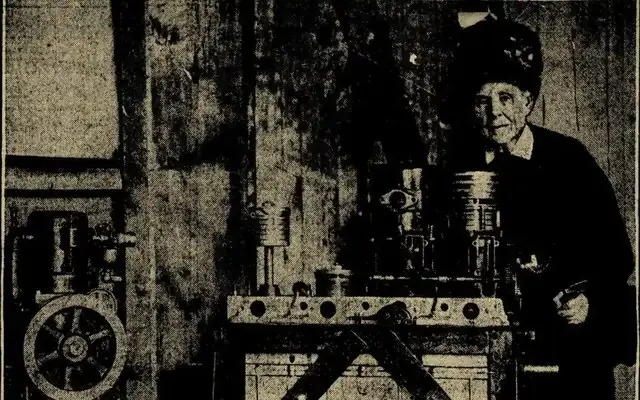
The illustration comes from a Boston Sunday Post photograph published on March 31, 1912. It shows Knight amid the equipment of her experimenting room, decades after her best-known patent. The crop concentrates on the photograph and omits the newspaper's misleading headline describing her as America's first female patent recipient. She was not. What the picture does preserve is more interesting than that false distinction: an older woman still identified with practical experimental work. Behind the ordinary bag stood a career of observation, workshop experience, and persistence in defending the results.