A prodigy with a different ambition
The witch of Agnesi is a curve, not a woman accused of sorcery. Its name attaches an unfortunate piece of translation history to Maria Gaetana Agnesi, an eighteenth-century Milanese mathematician. The graph rises to a rounded central crest and spreads outward toward a horizontal line. There is nothing occult about its construction. Yet this memorable name has often overshadowed the much larger book in which Agnesi discussed it, a teaching project that brought advanced mathematical methods into an unusually orderly and accessible form.
Agnesi was born in Milan in 1718 into a prosperous family supported by the silk trade. Private tutors developed her gift for languages and learning. At gatherings arranged by her father, she answered philosophical and scientific questions before distinguished visitors. This was scholarship performed in a household rather than a university lecture room. Accounts that make her father a mathematics professor repeat an error; his wealth, rather than a professorial position, provided the educational opportunity. Agnesi herself eventually sought a quieter life than these public displays allowed.
Making difficult mathematics readable
Her mathematical education included guidance from the monk and mathematician Ramiro Rampinelli. The resulting Instituzioni analitiche ad uso della gioventù italiana appeared in 1748 and addressed Italian students in their own language. Its scope reached from algebra and the treatment of curves to differential and integral calculus. Gathering such material was a substantial undertaking when methods were scattered among different authors. A reader needed a path through the subject, not simply a pile of impressive results. Organization and explanation were central to Agnesi's contribution.
Her correspondence with Jacopo Riccati shows that a book like this emerged through revision and consultation. Sections were examined, suggestions arrived, and printing had to be coordinated with work still under way. Agnesi acknowledged mathematical help rather than presenting herself as an isolated source of every result. Her reputation rested on making a demanding subject teachable. The distinction remains useful: a textbook can advance the circulation of knowledge even when its examples and methods have earlier histories. Clear exposition is intellectual work, especially when it joins techniques developed in different traditions.
How a curve became a witch
One of those earlier histories belonged to the curve later associated with her name. Fermat had considered it, and Guido Grandi had studied its construction before Agnesi included it. The Italian term versiera was connected with turning, through a Latin nautical expression. In the familiar explanation of the English nickname, translator John Colson confused that word with a similar Italian expression for a female devil or witch. His English version was published in 1801, decades after his death. The nickname belongs to the transmission of the mathematics, not to Agnesi's character or religious beliefs.
The curve itself can be understood without a sinister story. Its graph is symmetric about a vertical axis, reaches a maximum at the center, and approaches its horizontal asymptote as it extends to either side. A geometric construction using a circle produces its points. This combination of a drawing and an algebraic description made it suitable for discussing how equations and shapes correspond. Such examples helped readers move between the visual and symbolic sides of analysis. Agnesi's treatment gave an existing mathematical object a durable place in instruction.
A life beyond the textbook
Recognition brought an unusual academic offer. In 1750 Pope Benedict XIV arranged her appointment to a mathematics chair at Bologna, but she never went there to teach. It is therefore better to distinguish the appointment from a career actually spent lecturing at the university. After her father's death in 1752, her attention increasingly centered on religious life and the care of poor and ill women. She devoted resources and sustained personal effort to that work. Her withdrawal from mathematical publication was a choice within a longer life, not its disappearance from history.
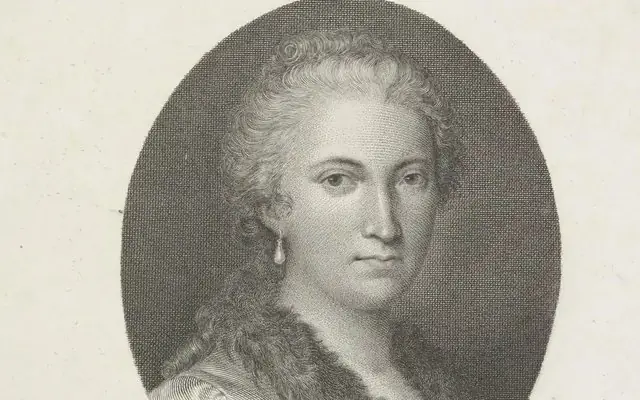
The illustration reproduces an engraved portrait by Ernesta Bisi after a drawing by Maria Longhi, preserved by the Rijksmuseum and released under CC0. The catalog dates the print broadly between 1798 and 1859; it should not be mistaken for a securely dated portrait from the moment her textbook appeared. Agnesi died in 1799. What survives of her mathematical career asks for similarly careful labels. She was neither the inventor of every method she explained nor the witch suggested by a mistranslated word, but a skilled author who made difficult learning easier to enter.