A book larger than its commission
In 1831, Mary Somerville published The Mechanism of the Heavens, a book that grew far beyond the straightforward translation its commission might suggest. It presented the mathematical astronomy of Pierre-Simon Laplace to English readers, adding explanation and a substantial introductory account. The author was a Scottish woman who had assembled much of her education through private study. At a time when university and scientific careers offered women few established routes, she made difficult ideas circulate through books. Her achievement involved understanding advanced mathematics well enough to decide how someone else could learn it.
Somerville's recollections describe the process beginning with curiosity rather than a planned scientific career. As a girl, she encountered algebraic symbols in a magazine and wanted to know what they meant. Euclid and algebra books eventually supplied material for more systematic study. She pursued mathematics among other activities expected of a young woman, including music, drawing, and household work. Her memoir was assembled late in life and published after her death with her daughter Martha's editorial contributions. It preserves her remembered experience, rather than a contemporaneous diary of every childhood lesson.
Learning through private work and public connections
Family circumstances could obstruct study or make it easier. Her first husband did not share her intellectual interests; after his death in 1807, she returned to Scotland and resumed them with greater independence. In 1812 she married William Somerville, who supported her work and helped sustain the practical connections it required. Friends, teachers, scientific acquaintances, and correspondence all mattered. Describing her simply as self-taught can obscure those relationships. She learned outside the usual institutions, but she did not acquire or communicate knowledge in complete isolation from the wider scientific community.
Henry Brougham invited her to explain Laplace's work for the Society for the Diffusion of Useful Knowledge. The challenge required much more than replacing French words with English ones. Laplace's arguments assumed mathematical preparation that many readers lacked. Somerville developed an account of the principles needed to follow the astronomy, then worked through the subject in depth. The result was published separately as a substantial work. Her preliminary dissertation also reached readers interested in the system of celestial mechanics who could not master all the calculations that followed it.
Recognition with limits
The project brought her into correspondence with leading scientific figures, including John Herschel and William Whewell. Their letters, reproduced in her recollections, show close attention to mathematical exposition and the book's value. Recognition nevertheless had institutional limits. In 1835, the Royal Astronomical Society awarded honorary membership to Somerville and Caroline Herschel, the first women to receive it. That honor should not be confused with election as ordinary Fellows, a route the society did not open to women until much later. Celebrating her intellectual standing does not require pretending that the barriers had disappeared.
Her next major book, On the Connexion of the Physical Sciences, appeared in 1834. It brought different branches of natural knowledge into relation, moving among subjects that specialists might otherwise treat separately. Revised editions allowed her to follow new results rather than presenting science as a finished monument. Physical Geography followed in 1848, and Molecular and Microscopic Science in 1869. These books give a sense of the range and duration of her work. She was still attempting to organize rapidly expanding knowledge at an age when many writers had long ceased publishing.
A lifetime of explaining science
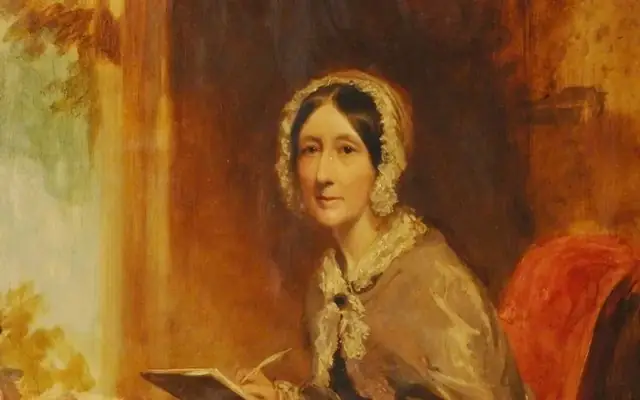
Somerville's life also included painting, which makes the accompanying self-portrait a particularly fitting image. Held by Somerville College, Oxford, it shows her seated with a book amid the furnishings of an interior. The college itself opened in 1879 and took her name after her death, so it was not an institution she attended as a student. The distinction captures a broader change: a woman whose advanced education had depended heavily on private opportunities later became the namesake of a college founded to extend women's access to university study.
She died in Naples in 1872, aged ninety-one. Her career is easy to compress into a list of famous acquaintances or honors, but its central labor was sustained intellectual work. She studied, checked, explained, and revised. A difficult foreign treatise could become the starting point for a new educational structure rather than merely an object to translate sentence by sentence. The story of The Mechanism of the Heavens is therefore also a story about access. Clear explanation required expertise, and the person providing that expertise had first overcome serious obstacles to acquiring it herself.