From musical glasses to a machine
Run a damp finger around the rim of a suitable drinking glass and the glass can sing. Eighteenth-century performers already knew this trick and arranged musical glasses into sets. Benjamin Franklin heard such performances while in London and imagined a different arrangement. Rather than making a player reach among separate goblets, he brought the vibrating surfaces together on a rotating shaft. His glass armonica turned a familiar dinner-table curiosity into an instrument that could carry a melody and sustain several notes together. The mechanism was ingenious, but the sound still began with a fingertip touching glass.
The Franklin Institute dates the completion of his instrument to 1761. Franklin's detailed description circulated the following year: the Library of Congress records his July 1762 explanation to the Italian natural philosopher Giambatista Beccaria. These dates refer to different stages of the invention's history, which helps explain why museum accounts sometimes attach 1761 or 1762 to it. The name armonica drew on an Italian word for harmony. It referred to Franklin's musical arrangement of glass, a very different machine from the small mouth organ now commonly called a harmonica.
The rim moves beneath the finger
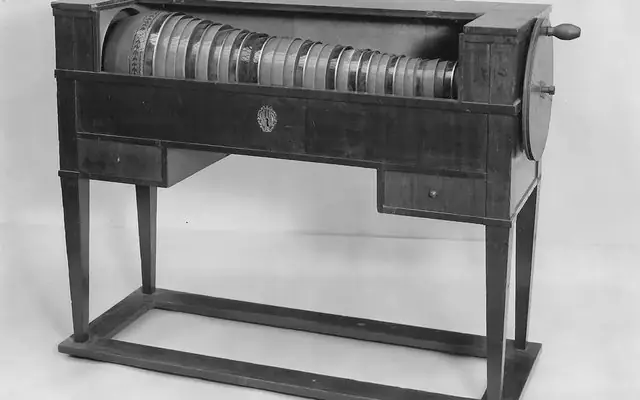
Its notes came from bowls of graduated sizes, fitted one inside another along a horizontal iron shaft. Cork fittings held the glass in position while keeping neighboring pieces from making unwanted contact. The rims remained accessible to the musician. A foot treadle turned the shaft, leaving both hands free to touch the moving edges with moistened fingers. This reversed the usual gesture of playing musical glasses: instead of a finger circling a stationary rim, the rim passed beneath the finger. Several fingers could therefore work at once without the same awkward travel between separate vessels.
This arrangement did not remove the craft from making an instrument. The bowls had to fit together and produce the intended pitches, tasks requiring careful blowing and grinding. Corning Museum of Glass preserves a later example with bowls dated 1818–1830, probably made by C. T. Pohl, and explains the demanding manufacturing process. Its case has a foot mechanism and a wheel attached to the shaft. Such surviving instruments show that Franklin's idea needed both a mechanical system and highly specialized glasswork. A design on paper was only the beginning of producing a reliable musical object.
Music and instructions cross borders
The new sound attracted serious musical attention in Europe. The Library of Congress identifies Mozart among the composers who wrote for the instrument, while its Franklin exhibition also notes Beethoven. Yet an unusual timbre did not guarantee that an instrument would project successfully in every ensemble. In a letter of August 15, 1765, preserved by the Library, Franklin asked Francis Hopkinson whether a recent armonica performance had pleased its listeners or been overwhelmed by the other instruments. The question is revealing: even an enthusiastic inventor needed reports from the practical world of rehearsals, players, and audiences.
The correspondence also carried the invention across languages. The Library's Music Division holds a rare Turin pamphlet of 1769 that printed Franklin's letters to Beccaria and described the instrument. A musical machine could thus travel through written instructions as well as through an actual wooden case packed with fragile glass. That circulation makes the armonica a useful example of eighteenth-century exchange. A listener's fascination in London became an explanation for an Italian correspondent, a subject for publishers, and an opportunity for instrument makers and musicians elsewhere to adapt the same underlying arrangement.
A strange sound and its reputation
Its eerie tone also acquired an uneasy reputation. Historical accounts collected by the Franklin Institute and Corning describe suspicions that playing or hearing it could harm the nerves, alongside stories of illness and prohibitions. These are evidence of what people feared or claimed, not proof that the instrument caused those conditions. The Franklin Institute explicitly notes the absence of a demonstrated explanation for the supposed effects. Repeating the alarming stories as established medical fact would obscure the more interesting historical question: how a novel sound could become both a fashionable pleasure and a focus of anxiety.
The photograph accompanying this story shows an eighteenth-century glass harmonica in the Metropolitan Museum of Art, catalogued as possibly German. It is an example of the instrument type rather than a claim to show Franklin's own personal machine. Its visible bowls, case, and supporting structure make the basic transformation easy to grasp. A small sensation that many people could reproduce became a coordinated apparatus for two hands and one foot. The armonica's enduring appeal lies partly in that connection between ordinary experience and invention: the music was unexpected, even though the physical action was already familiar.