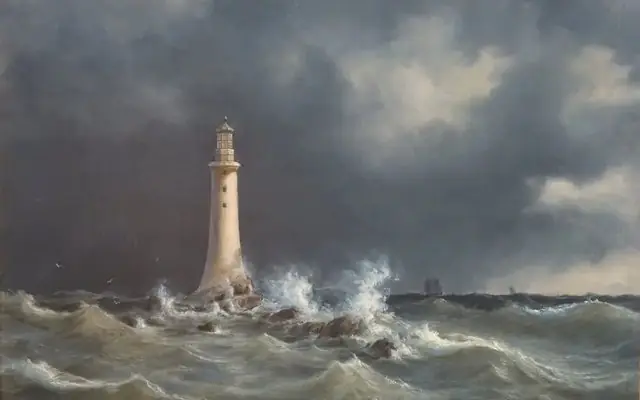
A tower with an offshore past
A lighthouse now standing on Plymouth Hoe once occupied a far less comfortable address: an exposed reef in the English Channel. Its designer, John Smeaton, had to make a tall structure survive waves strong enough to engulf it. The tower completed in 1759 became a celebrated engineering achievement, yet its eventual removal was not simply the story of a building falling apart. The sea was undermining the rock beneath it. Much of the structure could be taken down and reconstructed ashore, leaving an extraordinary reminder that a foundation can fail before the building it supports.
The Eddystone site already had a difficult history. Henry Winstanley's lighthouse, completed in 1698, was destroyed in the great storm of 1703. John Rudyerd's replacement lasted much longer but burned in 1755. Mariners still needed a light warning them away from the dangerous rocks. Recommended through the Royal Society, Smeaton came to Plymouth in 1756 to plan another replacement. He was taking on a problem in which architecture, shipping, weather, and materials could not be considered separately. A design that worked on a sheltered street might be useless on a reef.
Carpentry principles in stone
Smeaton's familiar source of inspiration was an oak tree. A broad, spreading base and narrowing upper trunk suggested a form that could remain stable while meeting powerful lateral forces. The resemblance was structural rather than decorative. His tower was built from stone, with carefully shaped blocks connected by dovetail joints and additional fastenings. Such joints resemble techniques used by carpenters: a widened end resists being pulled straight out of its socket. Applied to masonry, this helped neighboring pieces act together instead of behaving like a loose stack of heavy objects.
The material between the stones mattered too. Smeaton investigated hydraulic lime, whose useful property was its ability to harden in wet conditions. This was essential where the tide and spray repeatedly interrupted construction. It would be misleading to call the lighthouse a tower of modern Portland cement; the important historical development was experimentation with binding materials appropriate to the site. Blocks were prepared near Plymouth and transported out by boat. Engineering therefore extended from the shape of a joint to the organization of an entire journey between the shore workshop and the rock.
People, candles, and published plans
The workers faced hazards beyond waves. Britain was at war, and naval press gangs could seize men for service. Trinity House arranged identifying medals to protect the lighthouse workforce from impressment. This small administrative device belonged to the same project as the great stone tower: without the skilled people needed to place the blocks, drawings alone could accomplish little. In 1759 the new light began operating with twenty-four candles. The structure's survival made a persuasive public demonstration of the value of coordinated design, material testing, and practical experience under exceptionally difficult conditions.
Smeaton also explained his work in print. His illustrated account appeared in 1791, and plates preserved in the Linda Hall Library show both the completed elevation and the carefully arranged foundation courses. These drawings make an apparently simple outline legible as a complicated assembly. Later engineers could study how the pieces fitted together rather than merely admire the silhouette. The Institution of Civil Engineers identifies the tower as an important model for Robert Stevenson's Bell Rock lighthouse. Its influence traveled through an intelligible construction method as well as through its reputation for endurance.
A new life above Plymouth Sound
By the later nineteenth century, deterioration of the underlying rock made a replacement necessary. James Douglass's new Eddystone lighthouse opened in 1882. The upper part of Smeaton's structure was moved to Plymouth Hoe during the early 1880s, while a stump remained at the offshore site. Historic England records the resited tower as a Grade I listed building. Its present setting changes what visitors encounter: a former working aid to navigation has become a monument to the engineer and to the labor and practical decisions that sustained an exposed coastal light.
The accompanying painting offers another way to read that reputation. Anton Melbye's Eddystone Lighthouse, dated 1846 in the National Gallery of Denmark's collection, sets the tower amid a dramatic sea and sky. It is an artist's interpretation, not a measured record of a particular wave or storm. The surviving masonry and the construction drawings answer different questions from the painting. Together they show why the lighthouse became memorable: its silhouette made human persistence visible, while its less visible joints and mortar made that persistence possible.