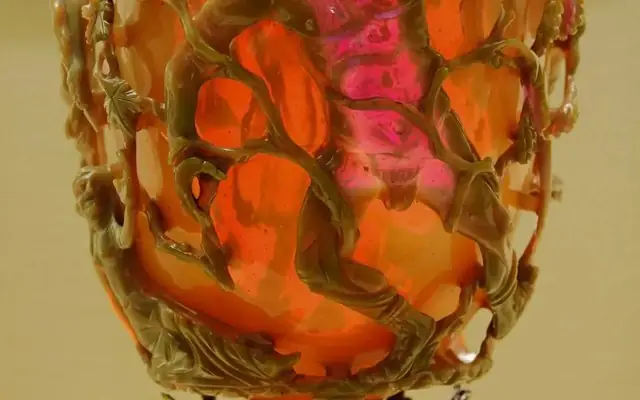
A vessel that changes with the light
A small Roman cup can look like two different objects without changing its temperature or receiving a coat of paint. With light falling onto it, its glass appears green; when illumination passes through the vessel, it glows red. This is the celebrated effect of the Lycurgus Cup, preserved in the British Museum. The transformation belongs to the glass itself rather than to a concealed mechanism. Moving the source of light changes what the viewer sees, making a drinking vessel into a surprisingly active visual experience. The Corning Museum of Glass includes it among its celebrated glass wonders.
The British Museum dates the cup to the fourth century CE, during the later Roman Empire. Its name comes from the story carved around its surface: the punishment of Lycurgus, a mythical king who opposed Dionysus, the god associated with wine. Although the object is commonly called a cup, its decoration demands attention as sculpture. Figures and curling vegetation project beyond the wall that would contain a drink. The surviving artifact therefore brings together the form of a vessel, the drama of a myth, and a material that alters its appearance under different lighting conditions.
A myth carved into a cage
It belongs to a rare family of luxury vessels known as cage cups. Their decoration stands away from the inner body, connected by small bridges of glass. The usual explanation of their manufacture involves cutting and grinding a thick blank until an openwork design remains. Every opening required material to be removed without breaking the fragile connections. On the Lycurgus Cup, the design is especially ambitious because the cage consists of figures and plants rather than a simple repeating lattice. This makes its physical survival almost as arresting as its color. The ornament is structurally part of the vessel.
The myth also rewards a closer look. In the version explained by the British Museum, Lycurgus attacked Dionysus and his followers, including the nymph Ambrosia. She appealed to Mother Earth and became a vine, which wound around the king and trapped him. The cup shows his struggle while divine figures and companions surround him. These are episodes from religious storytelling, not portraits of a documented royal defeat. Their arrangement lets a viewer follow the action around a curved surface. The vessel's intricate vegetation does double duty, creating the openwork structure while showing the very bonds that restrain its central figure.
Tiny particles and a careful explanation
Modern investigation revealed a second world inside the material. A scientific account by Ian Freestone, Nigel Meeks, Margaret Sax, and Catherine Higgitt describes minute particles of a silver-gold alloy in the glass. Electron microscopy identified particles typically tens of nanometers across. They affect the way light interacts with the vessel, producing the contrasting appearance in reflection and transmission. The amounts of precious metal are small; this is not a cup made from a mass of gold. Its remarkable color depends on the form and distribution of tiny particles within a much larger body of glass.
That finding is often summarized as Roman nanotechnology, but the phrase needs care. Identifying nanoscale particles today does not show that ancient craftspeople possessed electron microscopes or modern atomic theory. The same research stresses the importance of composition, heating, and chemical conditions. Exactly how the original makers arrived at their successful material remains uncertain. Their practical experience could be extremely sophisticated without being expressed in modern scientific language. The cup is evidence for an exceptional workshop achievement; it cannot by itself establish a complete recipe or tell us what its makers believed was happening inside their glass.
A masterpiece within a wider craft tradition
A fragment in the Metropolitan Museum of Art helps put this masterpiece into perspective. That Roman cage-glass fragment also combines a figure in relief with glass that appears different in reflected and transmitted light. Its survival shows that the Lycurgus Cup was not an isolated object entirely detached from other Roman experiments. At the same time, the fragment makes the larger cup's preservation especially valuable. An incomplete rim can establish a technique, while a substantially surviving decorated vessel allows material, shape, and narrative to be studied together. Exceptional survival should not be mistaken for evidence that no related work ever existed.
The wider Roman glass tradition was varied, as the Getty's survey of Greek and Roman glass demonstrates: vessels could be blown, molded, colored, layered, and cut to very different effects. The Lycurgus Cup belongs within that inventive craft world, even while it occupies an extraordinary place in it. Its appeal today does not require a lost secret more advanced than modern science. A more interesting story lies in the meeting of skilled hands, learned habits, expensive materials, and a myth made visible. The change from green to red invites wonder; careful study explains why that wonder has such durable historical value.