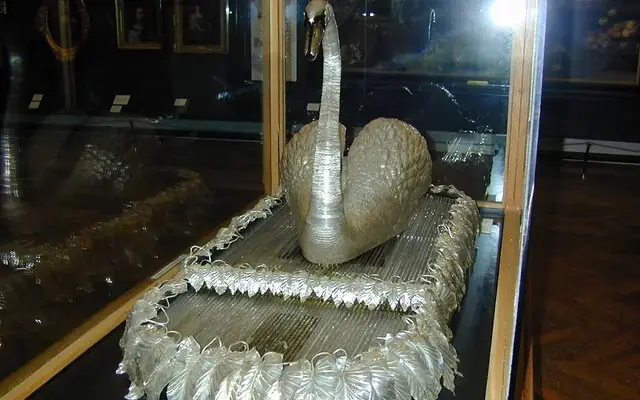
A bird made from silver and motion
A silver bird lowers its neck toward a glittering pool, appears to catch a small fish, and raises its head to swallow. The performance is a mechanical illusion, but the movements have persuaded generations of viewers to describe the creature as lifelike. The Silver Swan, now in the Bowes Museum at Barnard Castle in England, was made around 1773. It belongs to a world of elaborate automata in which clockwork, precious materials, music, and showmanship were combined to turn a short sequence of movements into an attraction.
The swan emerged from the London workshop associated with James Cox, a jeweller and entrepreneur whose business produced richly decorated mechanical curiosities. Cox employed skilled makers rather than personally creating every part of the objects sold under his name. The Bowes Museum credits John Joseph Merlin with the complex mechanism controlling the swan's head and neck. This division of work matters. The finished bird invites attention as a single creature, but its apparent unity depends on specialized contributions that had to operate together inside a coherent design.
A performance divided among mechanisms
The museum describes three clockwork mechanisms: one for the music, one for the imitation water and moving fish, and one for the neck and head. Rotating glass rods create a shimmering surface instead of a pond filled with real water. The swan's articulated neck can bend through a sequence that suggests an animal preening and feeding. These are arranged actions, rather than choices made in response to hunger. The ingenuity lies in controlling their timing so that separate physical effects become a recognizable little scene.
The distinction becomes clearer when attention shifts from the bird to the supposed pool. Light on moving glass supplies the impression of water, while silver fish give the downward movement of the head a purpose. The viewer connects these parts into a familiar story about a feeding swan. Precious metal alone would make a valuable sculpture, but movement turns the object into an event with a beginning and an ending. Its makers were designing a performance as well as constructing an object that could stand in a display case.
From London spectacle to museum collection
The swan attracted audiences in Cox's mechanical museum in London and later appeared at the Paris International Exhibition of 1867. Mark Twain saw it there and described the encounter in The Innocents Abroad. His account praises its graceful movement and follows its capture and apparent swallowing of a fish. The same passage then wanders toward the people around him, a reminder that the exhibition was crowded with competing attractions. The bird's success lay partly in holding attention long enough for its brief action to seem like the behavior of a living creature.
Joséphine and John Bowes also encountered the swan at the Paris exhibition. It subsequently became part of their collection, which formed the foundation of the museum that opened in 1892. The museum's accounts differ on the precise acquisition year: its current collection page gives 1873, while its historical blog gives 1872. Both associate the purchase with John Bowes and a price of £200. Keeping that small discrepancy visible is preferable to pretending every stage of a famous artifact's journey is recorded with equal clarity.
Keeping a moving object alive
A moving museum object presents problems that a static sculpture does not. Parts can wear, adjustments can change behavior, and maintenance must balance performance with preservation. The museum records a major conservation project in 2008 that cleaned and documented the components. Performances stopped during the pandemic, and a study in 2021 assessed the work required. Further conservation in 2023 and 2024 involved clock specialists, museum staff, and trainees. The National Lottery Heritage Fund records a grant supporting that project, evidence of the resources required to keep the mechanism usable.
The swan's history therefore includes both its original makers and the later people who studied, repaired, funded, and operated it. Preserving only the silver exterior would retain its appearance while losing an essential part of the experience. Running it without regard to wear would create a different problem. Its continuing appeal rests in the careful relationship between those aims. A creature that never needed food still requires human care, and a fish-catching illusion devised in the eighteenth century survives through very real work in the present.