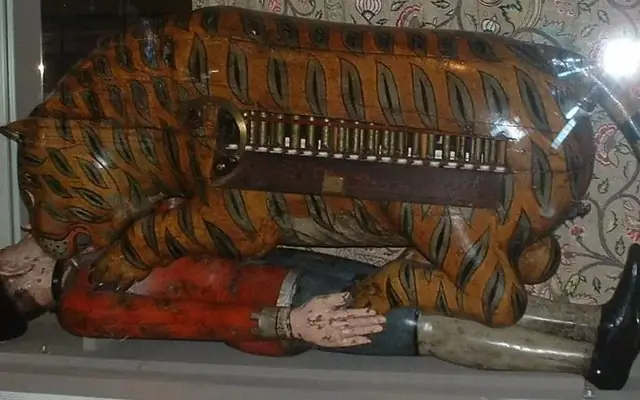
A tiger with a hidden keyboard
A striped wooden tiger bends over a European man lying on his back. The scene is dramatic even before anyone touches its handle. Turn the mechanism, and the man's arm can rise and fall while sounds suggest the animal's growling and its victim's distress. Behind a flap in the tiger's side is a keyboard for a small organ. This remarkable object, known as Tipu's Tiger, combines sculpture, music, and political imagery. It was made in Mysore in southern India around the 1790s for Tipu Sultan.
Tipu ruled Mysore from 1782 until 1799 and resisted the expanding power of the British East India Company. The tiger was his personal emblem, appearing across possessions associated with his rule. The Victoria and Albert Museum describes tiger forms and stripes on weapons, coins, and throne ornaments. Seen in that company, the wooden animal becomes more than an eccentric entertainment. It gives a repeated royal symbol a moving body and a voice. Its European victim makes the scene's connection with the ruler's enemies unmistakable.
A ruler’s emblem made mechanical
The object is often called an automaton, but it needs a human operator. Its performance depends on someone turning a handle, with the internal mechanism supplying movement and sound. A keyboard allows the concealed organ to function as a musical instrument as well. Calling it a machine that acts entirely by itself would obscure that partnership. The sculpted exterior establishes the story, while the operator activates the effects. Viewers see a fierce animal, although the action is produced through the deliberately coordinated work of carved material and mechanical parts.
Its theatrical qualities also invite careful interpretation. The scene represents an attack; it is not a record of a particular event that a photographer or eyewitness captured. Nor does its striking appearance tell us everything about its makers or original performances. The V&A's collection material identifies an unknown maker and dates the work approximately. Those limits leave room for inquiry without requiring an invented workshop story. What survives securely is an object commissioned for a ruler whose tiger imagery and conflict with the Company are well documented.
A captured object changes its audience
In 1799, the Company's forces and their allies took Tipu's capital, Seringapatam, now Srirangapatna. Tipu was killed, and the city was looted. The tiger was removed from his palace and sent to Britain. This transfer is essential to its later history: it did not travel as a routine purchase chosen by a collector from a peaceful market. The V&A's account places it within the aftermath of conquest. A symbol belonging to the defeated ruler became property displayed by the commercial and military power that had fought him.
At the East India Company's museum in London, the tiger drew an enthusiastic public. Its meaning could now be reversed by its surroundings. An object that showed a European enemy beneath Tipu's animal emblem could be exhibited as evidence of Britain's victory over Tipu himself. The Metropolitan Museum's discussion of a modern artwork responding to the tiger describes this transformation into an imperial trophy. Museum presentation does not erase an earlier meaning; it adds another audience, another ownership history, and another way of explaining what a visitor sees.
Looking inside a famous museum exhibit
The tiger subsequently entered the South Kensington Museum, now the Victoria and Albert Museum. Conservation has supplied a further way to study it. In a recorded account, V&A conservator Nigel Bamforth explains the examination of interior surfaces, photographic documentation, wood samples, and paint layers. These investigations ask questions that a dramatic performance alone cannot answer. Which surfaces belong to the original object? What has been altered or repainted? The outer spectacle and the inner evidence belong to the same artifact, but each requires a different kind of attention.
Tipu's Tiger remains memorable because it operates on several levels at once. It is an unusual organ, a moving sculpture, a royal emblem, and an object taken in war. Looking only for the amusing mechanism would miss its political history; reading only the politics would miss the ingenuity of its physical construction. Together, these features explain why it continues to attract interpretation. A handle can animate the carved scene, while its journey from Mysore to London reveals how an object's significance changes when power and audiences change around it.