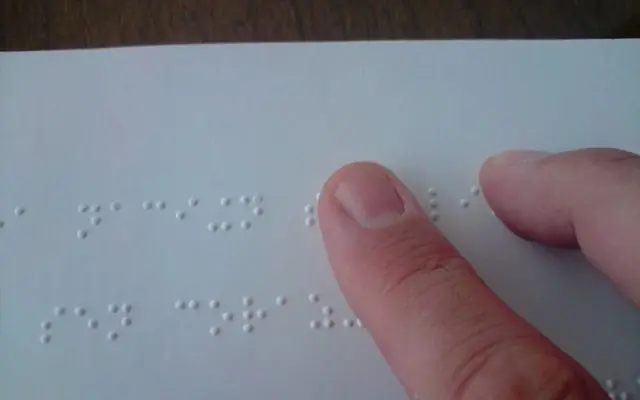
Learning to read with the hands
Six raised dots can look like a very small invention. Arranged in two columns of three, however, they provide the basic cell of a reading and writing system used across many languages. Louis Braille developed that compact structure as a young student in France during the 1820s. Its importance lay in treating touch as a way of reading with its own requirements. Instead of asking fingers to follow the outlines that eyes recognize, his system offered small, distinct patterns designed to be felt.
Braille was born in Coupvray in 1809 and lost his sight after an accident in childhood. In 1819 he entered the school for blind pupils in Paris. Methods of tactile reading existed already, including raised forms of ordinary print letters. Such books demonstrated that written material could be read through the hands, but reproducing visual letter shapes was not the only possible approach. Braille encountered an alternative during his education: Charles Barbier's system of raised points, along with the tools used to make them.
Six positions and a compact pattern
Barbier deserves a place in the story because Braille's work developed from an existing experiment. His larger arrangement used twelve dot positions and represented sounds. The Royal National Institute of Blind People records that Braille considered it too complicated and worked toward a smaller version. By 1824, when he was fifteen, he had devised a six-dot cell. That reduction changed the scale of recognition. A reader could encounter the whole compact pattern beneath a fingertip, rather than treating a large sign as a shape to explore in separate parts.
Each of the six positions can be raised or left empty. There are therefore sixty-four possible arrangements if the completely blank cell is included, or sixty-three patterns containing at least one dot. These do not have to function only as separate letters. Their meaning depends on the code and context in which they appear. The system can represent punctuation and numbers as well as an alphabet. Thinking of it as a code is useful: braille can express different languages without becoming a separate spoken language of its own.
Writing as well as reading
Braille also addressed the ability to produce writing. With a slate and stylus, a person presses points into paper so that raised dots can be read from the other side. This requires the writer to account for the reversal between the side being punched and the side being read. It is a practical detail with a large consequence. Access to a prepared book is one achievement; being able to compose a private note, keep a record, or work through a lesson independently is another.
The first published account of Braille's system appeared in 1829 and included a music code. Music was therefore part of the project early in its history, rather than a decorative addition made long afterward. Braille remained at the Paris institute as a teacher. His work joined personal experience, repeated refinement, and a setting where students needed usable educational materials. The result was a method whose small signs could carry organized knowledge well beyond the simple act of naming individual objects or recognizing a few familiar words.
A code that outlived its inventor
Acceptance did not arrive everywhere at once. Braille died in 1852, and the French adoption commonly dated to 1854 came after his death. RNIB notes resistance connected with the fact that the dots did not resemble print and were consequently unfamiliar to sighted readers. This reveals a tension in the history of accessible design. A method convenient for the person using it can still meet opposition from institutions accustomed to judging information through a different sense. Later adoption required teachers, publishers, and readers as well as a workable code.
The six-dot cell also proved adaptable to new tools. Embossing machines can produce paper texts, while refreshable displays raise and lower dots to show electronic material. These devices change how the patterns are supplied, but preserve direct reading through touch. Braille's achievement consequently extends beyond a nineteenth-century schoolroom. He helped establish a way to handle written language that could travel between paper, music, and electronic equipment. A small repeated arrangement gave readers access to a large and expanding field of expression.