A problem at the dinner table
The dishwasher began its successful commercial life in a setting rather different from the ordinary family kitchen. Josephine Cochrane developed a machine that could clean tableware without the repeated handling that chipped her china, then found customers among hotels and restaurants. Her story connects the practical arrangement of plates with the less visible work of raising money, persuading buyers, and running a factory. The invention mattered because she carried it beyond a promising mechanism into a business capable of supplying people who needed it.
Born in Ohio in 1839, Cochrane lived in Shelbyville, Illinois, where she and her husband entertained guests. Historical accounts describe her frustration when servants damaged dishes during washing. She tried doing the task herself and found it tedious. This origin needs some perspective: she was not initially trying to escape a lifetime spent at a household sink. She was an affluent hostess protecting valued possessions. After her husband died in 1883, however, debts made the prospect of earning money from her design much more urgent.
A patent built around dishes and water
Earlier inventors had already attempted mechanical dishwashing. Cochrane's achievement was to produce a commercially successful approach, rather than conceive the entire idea from nothing. Working with mechanic George Butters, she developed an arrangement that held dishes in fitted wire racks while water did the cleaning. The dimensions of actual plates and cups mattered. A machine that knocked them together would reproduce the problem it was intended to solve. Holding tableware securely and exposing its surfaces to water were connected parts of the design.
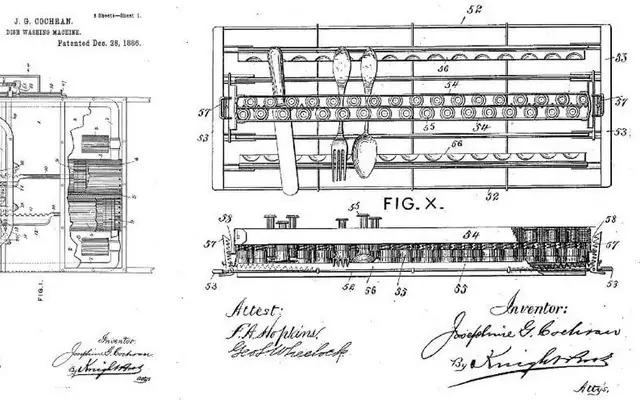
Her United States patent, number 355,139, was issued on December 28, 1886. The specification describes a rotating crate containing dish cages, supplied with soap solution or clear hot water. Its detailed drawings include pumps, spray pipes, a driving mechanism, and separate holders for different utensils. The document is useful evidence against imagining a fully formed modern appliance. It records a particular mechanical arrangement, assembled from many components, whose operation depended on coordinated movement and water supply. The familiar household dishwasher would emerge through further development.
Selling a machine meant selling an idea
Finding buyers required another kind of invention. Cochrane approached Chicago hotels, including the Palmer House and Sherman House, and secured orders. In its historical account, the United States Patent and Trademark Office describes the difficulty she faced entering business spaces and seeking investment as a woman. The work involved more than explaining a clever device. She had to convince managers that the purchase would justify its cost, while retaining control of a company that potential investors sometimes wanted men to run.
The World's Columbian Exposition in Chicago in 1893 offered a particularly effective demonstration. Her machines were shown and used in the fair's food operations, and the design received an award. A restaurant could judge the appliance against repeated loads of dirty crockery rather than a household's occasional wish for convenience. Large institutions had both an economic reason to reduce repetitive labor and the facilities to support a demanding machine. Publicity at the exposition helped connect Cochrane's apparatus with a market that could actually use it.
Why the household market had to wait
Homes presented different obstacles. Machines were expensive, and many domestic hot-water systems could not supply what they required. MIT's Lemelson account also notes problems with soapy residue and resistance among potential household users. A useful appliance does not become universal simply because its mechanism works. Purchase price, plumbing, detergent, and established habits all shape adoption. Cochrane established her own factory around 1898, with Butters managing it, but restaurants and hotels remained more reliable customers than the broad household market she had hoped to reach.
Cochrane died in 1913, before dishwashers became common domestic equipment. Her enterprise was later acquired by Hobart, linking it with the development of KitchenAid dishwashers. This long commercial afterlife makes the story more interesting than a single triumphant patent date. The machine had to fit dishes, then institutions, and eventually the changing infrastructure of homes. Cochrane's distinctive accomplishment was to move between those scales: from protecting a fragile plate to organizing the manufacture and sale of a device that could perform the task repeatedly.