A signature in Shakespeare’s birthplace
In 1851, Ira Aldridge visited Shakespeare's birthplace while performing in Stratford-upon-Avon. The visitor book records more than the presence of a famous actor. He added words from The Merchant of Venice about judging a person by complexion, and he presented himself through an African identity that formed part of his theatrical persona. A handwritten entry connected literature, publicity, and the prejudice he encountered. Aldridge had already spent years building a career on the road. The town associated with Shakespeare offered a stage, an audience, and a place to leave a deliberate mark.
He was born in New York in 1807 to free African American parents and attended the African Free School. Britain became his destination in 1824, when racial barriers made an American stage career exceptionally difficult. The National Portrait Gallery records his appearance as Othello at London's Royalty Theatre the following year. The role placed a Black performer at the center of a Shakespearean tragedy frequently presented by white actors in dark makeup. His achievement required skill, but skill did not ensure that the theatrical establishment would treat him as an equal professional.
Finding the actor behind the catalogue
By 1828 he was managing the Theatre Royal in Coventry and speaking against slavery. The Herbert Art Gallery and Museum identifies him as Britain's first Black theatre manager, but its archivists also explain how easily evidence of his work can disappear inside a catalogue. Searches for his personal name missed reports that called him the African Roscius, a reference to the celebrated Roman actor. A second difficulty involved the building itself: the loose label Coventry Theatre obscured its formal name, Theatre Royal. Changing the search terms recovered a theatrical presence that the initial results concealed.
London remained both an opportunity and a source of hostility. In 1833 Aldridge replaced Edmund Kean as Othello at Covent Garden. A surviving playbill held by the Folger Shakespeare Library advertises the engagement in April of that year. The National Portrait Gallery describes favorable audience responses alongside reviews shaped by racism. The contrast matters because applause and institutional acceptance were different things. A performer could attract spectators while critics questioned his right to occupy a prestigious stage. His subsequent travels were a professional strategy within an unequal theater world, not evidence that ambition had run out.
A repertoire and a political voice
Aldridge's repertoire was wider than one famous part. He performed Black characters as well as roles conventionally assigned to white actors, including Shylock, Richard III, Macbeth, and Lear. Touring British towns offered work and public recognition beyond the small circle of influential London theaters. The National Portrait Gallery's educational account also records his practice of addressing audiences against slavery near the end of an engagement. A curtain call could become an occasion for political speech. The theatrical audience was therefore more than a market for tickets: it could also become a gathering to which an actor made an argument.
The Stratford visit demonstrates how varied that work could be. The Shakespeare Birthplace Trust preserves playbills for his eight-day stay, beginning with Othello on April 28, 1851. He appeared in seven plays and visited the Birthplace twice. His programs included comedy as well as tragedy, and the publicity could praise his ability while packaging his race as a novelty. The surviving advertisements deserve careful reading for both reasons. They document a successful professional engagement, but the language used to sell that engagement also exposes assumptions about Black performers that success did not simply erase.
A career across borders
Continental Europe gave Aldridge a still larger field for his work. His reputation grew through tours rather than depending on approval from a single capital. The Folger's collection includes correspondence that shows the labor behind such movement: arranging engagements, discussing payment, and preparing the next appearance while still performing elsewhere. Late in his career he hoped to return to the United States for a tour, but his death in Łódź in 1867 prevented it. The medals carried in his funeral procession reflected the honors accumulated by an actor whose working life had crossed many borders.
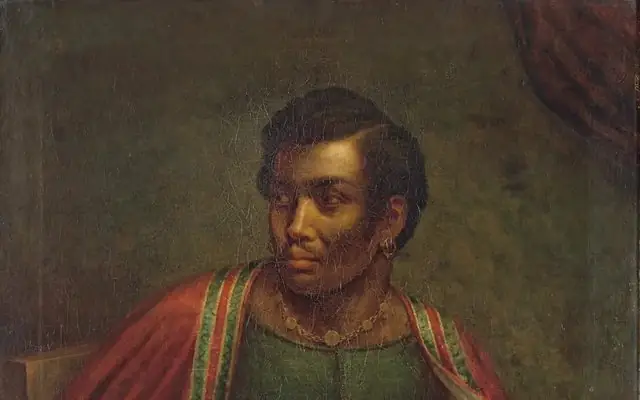
Henry Perronet Briggs's portrait of Aldridge as Othello, painted around 1830 and now in the Smithsonian's National Portrait Gallery, preserves an earlier moment in that career. The costume presents a performer through a part, while the direct presence of the sitter resists reducing him to a theatrical label. A portrait cannot recover his voice or reproduce an evening's performance. Letters, playbills, and visitor books supply other fragments. Together they make it possible to follow a resourceful professional through the systems that employed, advertised, admired, and restricted him, rather than remembering only an exceptional name.