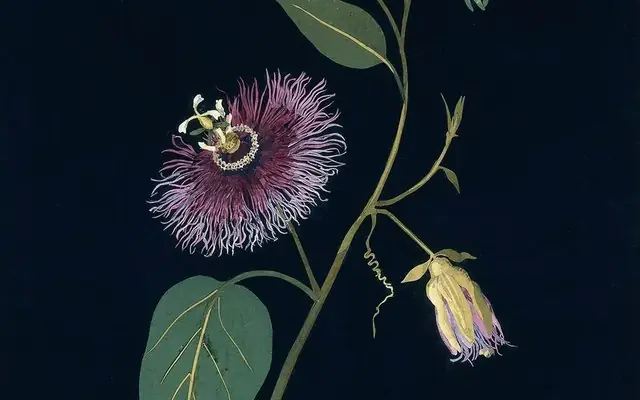
Flowers assembled with scissors
A flower against a black background can look deceptively simple until the viewer discovers how it was made. Mary Delany constructed botanical pictures from tiny pieces of colored paper, arranging and layering them until petals, leaves, and stems acquired convincing form. She called these works paper mosaics. Beginning this project at about seventy-two, she produced a collection of 985 examples. Their appeal lies partly in the surprise of the material: something that appears fluid and painted turns out to have been built through cutting, positioning, and patient assembly.
The British Museum recounts an experiment prompted by a geranium and a piece of red paper. Rather than treating that moment as the invention of an artist from nothing, it helps to see the skills already available to her. Delany had practiced drawing, painting, needlework, and decorative crafts over many years. A petal required an accurate outline; convincing foliage required controlled color and overlap. Her late project brought trained hands to a fresh application. Seventy-two was the beginning of this particular undertaking, rather than the beginning of her creative life.
An artist before the paper garden
Born Mary Granville in 1700, she lived within the social world of Georgian Britain and Ireland. Her life included two marriages, widowhood, extensive correspondence, and friendships reaching into artistic and court circles. Clarissa Campbell Orr's biography places the celebrated collages within those relationships rather than isolating them as a charming hobby. This context matters because time, materials, access to gardens, and encouragement were unevenly available. Delany's achievement was personal, but the circumstances that supported it were also social. Her surviving work can reveal both dimensions at once.
The Yale Center for British Art's exhibition on Delany emphasized that range. Alongside botanical collages, it brought together textiles, drawings, manuscript material, and evidence of natural-history collecting. A reconstructed view of her world included a court dress embroidered with naturalistic flowers. Such objects connect work commonly classified as fashionable accomplishment with the close study of plants. The division between decorative art and serious observation becomes less convincing when the same maker is tracking the shapes of leaves in a garden, on fabric, and in cut paper.
A specimen with a social history
Her friendship with Margaret Bentinck, Duchess of Portland, was especially important. The duchess collected natural-history specimens, and her household brought people, plants, shells, and other objects into contact. Delany spent substantial periods with her after her second husband's death in 1768. The paper flowers belonged within this active culture of collecting and exchange. They could communicate affection as well as botanical information. A picture might preserve the appearance of a living specimen, while its associated record preserved the contribution of the person who supplied it.
Delany's Passiflora laurifolia of 1777 offers a specific example. The British Museum's account identifies the specimen's donor as John Stuart, third Earl of Bute, a former prime minister with strong horticultural interests. Joseph Banks and the Royal Botanic Gardens at Kew also supplied flowers for her work. These exchanges connected her table with gardens and collections beyond a single household. The museum's description allows the finished collage to be read as a record of a particular plant and of the relationships through which that plant reached the artist.
Looking closely at a surviving flower
The passion flower also rewards a slower look at its construction. Its complex center and branching forms required many decisions about edges, scale, and placement. The contrast with the dark ground makes separate parts legible, rather than hiding them inside a busy landscape. This is a representation assembled from another material, not a pressed plant. Its physical dimensions, approximately thirty-five by twenty-four centimeters, remind us how much precision fitted within a manageable sheet. Enlarged reproductions make those decisions easier to inspect, but can disguise the original work's intimate scale.
The collection eventually entered the British Museum in 1897 through a bequest from Delany's great-niece, Augusta Hall. Organized in ten albums, it has survived as an unusually extensive record of sustained attention. Its late start makes a memorable fact, but the flowers offer more than an encouraging age statistic. They preserve an experienced craftswoman's handling of materials, the circulation of living specimens, and the intellectual possibilities of friendship. Delany made an enduring garden from paper while remaining closely engaged with plants that continued growing outside it.