A discovery above Main Street
On the evening of October 1, 1847, Maria Mitchell looked through a small telescope from a rooftop on Nantucket and noticed something missing from her star charts. The building below was a bank, where her father worked and the family lived. The observer was also the local librarian. An unfamiliar patch of light would connect this apparently ordinary arrangement with astronomers across the Atlantic. Mitchell had discovered a comet, and establishing who had seen it first required a second kind of work: getting observations into the right hands.
Mitchell had grown up in a family that took scientific learning seriously. Her father, William, taught her mathematics and astronomy, and the island's maritime economy gave precision measurements an immediate purpose. Ships needed reliable navigation, and accurate clocks and celestial observations were practical tools. As a girl she helped with an eclipse observation and learned to check ships' chronometers. Her later discovery therefore grew from sustained practice. The telescope on the roof was a working instrument in a household already accustomed to careful observation, calculation, and comparison.
A medal needed correspondence
Her father wrote to William Cranch Bond at Harvard after the comet appeared. A Danish royal medal rewarded the discovery of telescopic comets, but the claim did not proceed automatically. The Maria Mitchell Association describes difficulties over the required notification procedure, with Harvard president Edward Everett helping to secure recognition. The medal eventually reached Nantucket more than a year after the sighting. An observer could be first at the telescope and still need advocates, letters, and administrative patience before that priority became an internationally accepted achievement.
The discovery brought an exceptional level of attention. In 1848 Mitchell became the first woman elected to the American Academy of Arts and Sciences. The Smithsonian also noticed: its records show that secretary Joseph Henry sent her fifty dollars as a reward, reported to the institution's regents in 1849. These were concrete forms of recognition, although admiration did not erase the inequalities surrounding women's scientific careers. Mitchell continued her library work after becoming famous. Her everyday responsibilities did not disappear when newspapers found an unusual astronomer to celebrate.
Scientific work beyond the discovery
Her scientific employment extended beyond searching for unexpected visitors in the sky. The United States Coast Survey engaged her and her father in observations that helped establish Nantucket's position. For the Nautical Almanac she performed calculations associated with Venus. Such work depended on repeated measurements and numerical accuracy rather than one dramatic discovery. Calling her a human computer describes this calculating role; it does not refer to a machine. The less spectacular assignments helped turn astronomical knowledge into information that navigators and other observers could actually use.
In 1865 Mitchell became Vassar College's first professor of astronomy. The college's observatory gave her instruments and a place to teach women through direct investigation. Her correspondence with Henry also reveals frustration: a building and apparatus did not guarantee time or funding for research. Teaching demands could crowd out scientific work. These letters complicate a simple success story in a useful way. A celebrated appointment opened opportunities, but maintaining a productive observatory still required money, professional connections, and the daily labor of training students.
Taking the classroom to an eclipse
Mitchell took that training beyond the campus. Vassar's archival exhibition records eclipse expeditions to Iowa in 1869 and Colorado in 1878. Students traveled with instruments to observe an event that could not be rescheduled to suit a timetable. The opportunity joined preparation, travel, teamwork, and a brief encounter with changing light. For women whose access to advanced science remained restricted, taking part in an observing expedition was itself significant. They were producing observations under real conditions rather than merely reading about discoveries made elsewhere.
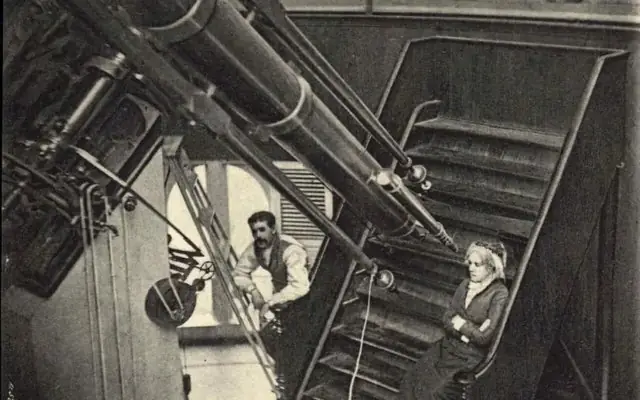
A historical photograph shows Mitchell inside Vassar's observatory in June 1878, surrounded by the machinery of her profession. It is a fitting companion to the rooftop story. The comet supplied an unforgettable beginning to her public career, but the observatory represents the work she helped other women enter. Mitchell died in 1889; the association established in her name in 1902 grew from family, friends, and former students. Her legacy includes a discovered object in the sky and a community trained to look carefully for themselves.