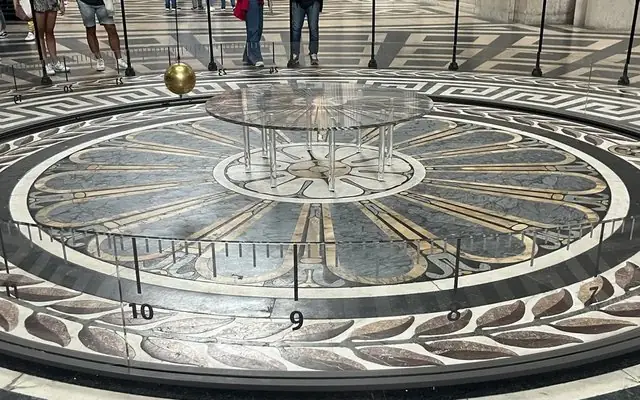
A moving Earth beneath a quiet floor
In 1851, a pendulum beneath the dome of the Paris Panthéon invited visitors to reconsider the floor on which they stood. A heavy sphere moved back and forth above a prepared surface, its pointed tip tracing successive passages through sand. The motion looked ordinary at first. Given time, however, the traces changed direction relative to the building. Léon Foucault had made an immense movement perceptible through a small, patient comparison. The experiment did not discover that Earth rotated. It offered an unusually direct way to demonstrate that rotation with an apparatus operating inside a room.
The installation joined scientific reasoning with skilled construction. With permission from Louis Napoleon Bonaparte, Foucault and the engineer Gustave Froment used the monument's great dome as a suspension point. Their steel wire measured 67 meters, and the brass-and-lead sphere had a mass of 28 kilograms. These were practical choices as well as impressive dimensions. The long suspension allowed a slow, expansive swing, while the substantial weight helped the motion persist. Woodwork and sand turned the floor into a recording surface. A movement too gradual to notice between two glances could leave a sequence of marks.
From a cellar to a monumental dome
The public spectacle followed smaller experiments. Foucault had begun in the cellar of his Paris home, and an installation at the Paris Observatory preceded the Panthéon demonstration. Moving into a monumental building enlarged both the apparatus and its audience. It also changed how a scientific argument could be encountered. Visitors did not need to peer through a telescope or accept a diagram of the heavens before seeing a result. They could watch a familiar swinging object, compare its path with the surroundings, and then hear why the comparison mattered. The demonstration made an abstract relationship into an observable event.
The essential comparison was between the pendulum's direction of swing and the rotating Earth beneath it. At the North Pole, the geometry is particularly easy to imagine: the ground and the observer turn around Earth's axis while an ideal freely swinging pendulum preserves its orientation in space. Seen from the floor, its direction therefore appears to rotate. Other latitudes require a more careful account of the geometry, but the changing direction still reveals Earth's rotation. This was a demonstration of the planet turning on its axis, rather than a demonstration of its annual journey around the Sun.
Why the visible turn depends on latitude
Location changes the rate of this apparent rotation. Near a pole, a full turn takes approximately a day; at the equator, this particular effect disappears. At intermediate latitudes, the full cycle takes longer than a day. In Paris it is roughly 32 hours. That distinction matters because a viewer might reasonably assume that a device showing Earth's daily rotation must complete its own visible circuit in 24 hours everywhere. The pendulum instead connects a universal movement with the observer's particular place on the globe. The same experiment produces different rates in different cities.
A real pendulum also differs from the ideal object in an explanation. Air resistance and other losses gradually shorten its swing, so it cannot operate forever without energy being supplied. Modern museum installations sometimes use an electromagnet to provide small, carefully timed impulses that maintain the motion. The University of California, Riverside describes such a system beneath its pendulum, while the Franklin Institute uses falling pegs to make changes of direction visible to visitors. Maintaining a swing and measuring its direction are separate tasks. Recognizing that distinction prevents a useful demonstration from being mistaken for a claim about perpetual motion.
An experiment with an interrupted history
The Panthéon experiment had a political setting as well as a physical one. The Centre des monuments nationaux records that the demonstration stopped amid the coup d'état of December 1851. Its history inside the building was therefore not one uninterrupted performance. Camille Flammarion later helped revive the experiment, and a permanent installation returned in 1995. Surviving instruments also entered museum collections: the Musée des arts et métiers preserves spheres associated with Foucault's experiments. A photograph of the modern Panthéon display should consequently be read as a view of the continuing demonstration, rather than as a photograph of the gathering in 1851.
Foucault's pendulum remains effective because its simplicity is carefully arranged. A wire, a weight, a starting direction, and a patient observer create a situation in which a planet's movement becomes measurable against the architecture of a room. The apparatus still needs an explanation; the marks alone do not announce their meaning. Yet it gives that explanation something tangible to work with. In museums and teaching buildings, visitors can follow the same question from an apparently stationary floor to a moving Earth. The enduring attraction is the conversion of an enormous physical fact into evidence at human scale.